Most lists of the best low light houseplants are really lists of plants that tolerate a dim room while quietly declining — they look fine for four months, then drop half their leaves and everyone blames themselves. The twelve below are different. Every one of them is listed by a university extension service or botanical garden as growing in partial to deep shade, which means a north-facing room, an interior office, or a corner ten feet from the nearest window is a place they can actually live, not just endure.
Each entry gives you the light it truly needs, the watering signal to watch for (not a schedule), mature size, and whether the ASPCA lists it as safe around cats and dogs. Then we cover the part almost nobody explains: why low light is what kills houseplants, and it isn’t the darkness.
Humble Acres is reader-supported. When you buy through links on our site, we may earn an affiliate commission at no extra cost to you — we only recommend products we’d use ourselves. See our affiliate disclosure.
The houseplant care kit
- Digital Illuminance Light Meter Tester 200,000Lux (18,500FC) Luxmeter — foot-candle light meter
- XLUX Plant Soil Moisture Meter, for Indoor and Outdoor use, Battery-Free — soil moisture meter
- Briignite Grow Light Bulbs, LED Grow Light Bulb A19 Bulb, Full Spectrum — full-spectrum LED grow bulb
- Craft Organic Houseplant Potting Mix, Chunky, Well Draining, Peat Free — chunky well-draining mix
- Southside Neem Oil Infused Plant Cleaning Wipes – Unscented — leaf cleaning wipes
Opens Amazon’s cart confirmation page — you review the list and prices there, and nothing is added until you approve it. Prefer to pick and choose? Every item above links to its own product page.
First, what “low light” actually means
Low light does not mean no light. Horticulturists measure indoor light in foot-candles, and the honest answer is that extension services don’t fully agree on where the bands sit. University of Missouri Extension and University of Minnesota Extension both put low light at roughly 50–250 foot-candles. UF/IFAS draws it tighter at 25–100. Clemson prefers 75–200. In lux — the unit most phone apps report — the common 50–250 foot-candle band works out to roughly 540–2,700 lux.
Two numbers cut through the disagreement, and they come from Clemson’s Home & Garden Information Center. About 100 foot-candles for 12 hours a day is the floor simply to hold a foliage plant at its current quality for a year. And below roughly 200 foot-candles, fertilizer does nothing — the plant can’t photosynthesize enough to use it. That second fact quietly explains a lot of failed rescue attempts: feeding a struggling plant in a dark corner is adding fuel to an engine that isn’t running.
The test you can run right now
You don’t need a meter. Minnesota Extension’s rule of thumb is that low light is bright enough to comfortably read a newspaper during the day without switching on a lamp. If you need the lamp, you’re below what any plant on this list can sustain, and you’re in grow-light territory.
If you’d rather have the number than the guess, a handheld light meter reads foot-candles directly and settles the question in about ten seconds per room. UF/IFAS notes that phone light-meter apps also work for this, while cautioning that their accuracy varies between devices. Take the reading at the spot where the plant will actually sit, at the time of day the room is dimmest — not at the window.
Distance and orientation matter as much as the window itself. Illinois Extension puts the low-light zone at a few feet back from a north window, three to ten feet from an east or west window, and fifteen to twenty feet from a south-facing one. Missouri Extension adds the blunt cutoff: beyond about ten feet from an average window, most low-light plants simply aren’t getting enough.
You may see a “shadow test” quoted around the web — sharp shadow means bright, fuzzy means medium, none means low. It’s a useful mental picture, but be aware it’s grower shorthand rather than a published standard; we couldn’t find it in a single extension or botanical garden source. The newspaper test is the one with an institution behind it.
The 12 best low light houseplants at a glance
| Plant | Shade tolerance | Water when | Mature size | Pet safe? |
|---|---|---|---|---|
| Pothos | Deep shade | Soil surface is dry | Vines 8–10 ft | No — oxalates |
| Snake plant | Very low light | Soil fully dry | 2–4 ft | No — saponins |
| ZZ plant | Deep shade | Soil fully dry | 2–4 ft | No — oxalates |
| Peace lily | Heavy shade | Soil dry, before wilt | 1–4 ft | No — oxalates |
| Cast iron plant | Heavy shade | Tolerates irregular | 2–3 ft | Yes |
| Chinese evergreen | Deep shade | Keep evenly moist | 1–1.7 ft | No — oxalates |
| Heartleaf philodendron | Shade (gets leggy) | Regular in growth | ~4 ft trailing | No — oxalates |
| Spider plant | Heavy shade | Water well in growth | 1–2 ft | Yes |
| Parlor palm | Heavy shade | Uniformly moist | 2–6 ft | Yes |
| Dracaena | Deep shade | Moist in season | 3–14 ft | No — saponins |
| Bird’s nest fern | Dappled only | Consistently moist | 3–5 ft | Not ASPCA-listed |
| Prayer plant | Dappled only | Evenly moist | 6 in–1 ft | Yes |
The list runs roughly from most forgiving to most demanding. If this is your first plant in a dark room, start in the top four and stop reading — you’ll do fine.
The 12 best low light houseplants, in detail
1. Pothos (Epipremnum aureum)
NC State rates pothos for “deep shade — less than 2 hours to no direct sunlight,” which is about as strong an endorsement as this category gets. Water when the soil surface is dry. Vines reach eight to ten feet indoors and it roots in a glass of water, so one plant becomes five.
The catch: golden and marbled varieties lose their variegation in dim rooms and revert toward plain green. That’s not a disease, it’s the plant maximizing chlorophyll. If you want the pattern, choose a solid green cultivar like ‘Jade’ and skip the disappointment. Trailing vines look best up high — a macramé hanging planter gets them out of the cat’s reach too, which matters here: pothos is toxic to cats and dogs (insoluble calcium oxalates).
Worth knowing: your pothos will never flower. Only the juvenile phase is grown as a houseplant, and flowering happens in the mature phase. Those dramatic split leaves you see online? They come from letting it climb a moss pole, which triggers the phase change — not from fertilizer.
2. Snake plant (Dracaena trifasciata)
Yes, the name changed — it was Sansevieria trifasciata until a 2017 reclassification moved the whole genus into Dracaena. Most nursery tags haven’t caught up. NC State says it “will tolerate very low light”; Chicago Botanic Garden notes growth is “quite slow in low-light situations, but plants perform well with minimal care.” Slow is the trade you’re making, and it’s a fair one.
Let the soil dry completely between waterings spring through autumn, and in winter water only every one to two months. Two specifics from Missouri Botanical Garden that prevent the most common deaths: never pour water into the center of the rosette (it rots from the crown out), and use a clay pot wider than it is tall, because a four-foot leaf span in a narrow pot topples. Toxic to cats and dogs via saponins. Full details in our complete snake plant care guide.
3. ZZ plant (Zamioculcas zamiifolia)
The darkest-room champion on this list, rated by NC State for deep shade with a growth rate of “slow” and maintenance of “low.” Reaches two to four feet in both directions.
Underneath the soil it grows potato-like rhizomes that store water — which is why it shrugs off a forgotten month and why nearly every dead ZZ plant died of kindness rather than neglect. It arrives carrying its own reservoir. Water routinely but let it dry out fully between drinks; wet feet are not tolerated.
A correction worth making: the ZZ plant is not in the ASPCA database, despite what a hundred blog posts claim in either direction. NC State independently rates it medium severity, toxic principle calcium oxalate, with vomiting and diarrhea if leaves are eaten in quantity. Treat it as unsafe around pets who chew.
4. Peace lily (Spathiphyllum)
Missouri Botanical Garden lists it for part to full shade and notes it tolerates heavy shade. Clemson calls it “one of the few foliage plants that will flower in low light” — the only genuine low-light bloomer here. It also tells you when it’s thirsty by drooping theatrically and recovering within hours, though repeated wilting does real damage, so aim to water just before the collapse.
The fact that will save you months of guilt: the blooms on the plant you bought were almost certainly chemically induced. UF/IFAS documents that commercial growers apply gibberellic acid (GA3) to force flowers 70 to 110 days later, precisely because it works “independent of environment.” Left alone, peace lilies initiate buds in the short days of December and January and won’t set flowers at all from June through August. A plant that stops blooming after you bring it home isn’t failing — it’s returning to its real calendar. Toxic to cats and dogs. See our full peace lily care guide for getting it to rebloom on its own schedule.
5. Cast iron plant (Aspidistra elatior)
Named for exactly the reason you’d guess. Missouri Botanical Garden lists it for heavy shade, tolerant of a wide temperature range, no humid atmosphere required, and “will tolerate less than regular watering.” Two to three feet tall, and famously slow — expect a handful of new leaves a year, not a flush.
Non-toxic to cats and dogs, which combined with its shade tolerance makes it the single best choice for a dark room with pets in it.
Strange but true: it flowers at ground level, half-buried in the leaf litter, and you’d never notice. Kobe University researchers found in 2017 that the flowers are pollinated mainly by fungus gnats — the plant appears to mimic a mushroom and emits a musty odor to sell the act. Overturning a century of belief that slugs did the job. Check under the leaves of a mature plant in spring.
6. Chinese evergreen (Aglaonema)
Rated for deep shade by NC State, and the most colorful plant that will accept it — silver, cream, and pink-veined cultivars all hold their patterning better in low light than variegated pothos does. One to one-and-a-half feet, medium growth, low maintenance.
Unlike the drought-tolerant plants above, this one wants the potting mix kept moist spring through fall. It is genuinely intolerant of cold — keep it in the 70–80°F range and away from drafty winter windows and air conditioning vents. Toxic to cats, dogs, and horses, and worth noting that the sap causes contact dermatitis, so wear gloves when you divide it. NC State also advises removing any flowers that appear: the spathes are unremarkable and drain energy from the foliage you actually bought it for.
7. Heartleaf philodendron (Philodendron hederaceum)
Missouri Botanical Garden gives the clearest too-dark warning of any plant here: “tolerant of shade, but if conditions are too dark, stems become spindly.” That’s your diagnostic. Long bare stretches of stem between leaves means move it closer to the window — the plant is stretching for light it can’t find.
The fix isn’t only light, though: pinch the trailing stems and it branches into a fuller plant. Leaf size doubles as a maturity readout — juvenile leaves run about four inches, mature plants push twelve. Water regularly in the growing season, back off from fall through late winter. Toxic to cats, dogs, and horses.
8. Spider plant (Chlorophytum comosum)
Tolerates heavy shade and is non-toxic to cats and dogs — one of only four genuinely pet-safe plants on this list. It survives low light happily; it just won’t produce many of the dangling plantlets it’s famous for without brighter indirect light. Accept the trade or move it to an east window when you want babies.
Those brown tips are probably not dry air. Missouri Botanical Garden lists three causes and the third is the one nobody checks: water high in salts and fluorides. Before you buy a humidifier, try switching to distilled or collected rainwater for a month. One more thing: the plantlets form on spent flower stalks, so deadheading a spider plant throws away your propagation material.
9. Parlor palm (Chamaedorea elegans)
The Victorian parlor plant, still earning its place: heavy shade tolerant, non-toxic to cats and dogs, and two to six feet of real architectural presence. Keep the soil uniformly moist in a peaty, soil-based mix; cut back watering and stop feeding in winter.
The one rule you must not break: Missouri Botanical Garden says “do not prune unless removing entire fronds or stems.” Palms grow from a single apical meristem at the top of a single trunk. Cut the crown to control height and that stem is finished — it cannot resprout the way a philodendron does. Trim browned frond tips only.
10. Dracaena (D. fragrans, D. marginata)
Corn plant and dragon tree both tolerate deep shade and grow slowly to anywhere from three to fourteen feet, making them the go-to for filling a dim vertical corner. Keep moist in the growing season, drier in winter, and above 50°F.
Fluoride is this genus’s specific weakness. NC State: dracaenas are “sensitive to fluorides and built-up salts, so if leaves turn brown, try watering with non-fluoridated water and flush salts monthly.” That monthly leach — running water through the pot until it drains freely for a minute — is the step almost everyone skips and the reason so many dracaenas have crispy tips. Toxic to cats and dogs via saponins, and here’s an unusually specific tell for pet owners: dracaena poisoning in cats causes dilated pupils, which distinguishes it from the calcium-oxalate plants.
11. Bird’s nest fern (Asplenium nidus)
The least shade-tolerant plant here and the only one we’d call fussy — it wants dappled light, not deep shade, and a narrow 60–70°F band. Include it because it’s the fern that most reliably survives a dim bathroom, where the humidity works in its favor.
In the wild it’s an epiphyte growing in the crotches of trees, not in soil, which is why NC State specifies a porous fern mix. Standard potting soil compacts and slowly suffocates it. Keep away from direct heat and drafts.
Two pet-safety corrections, and the second one matters: first, Asplenium nidus is not actually in the ASPCA database — the widely repeated “ASPCA-listed non-toxic” claim is unsupported (only the related A. bulbiferum is listed). Second, and more seriously: ASPCA’s entry for “Golden Birds Nest” is Sansevieria trifasciata — a snake plant, and toxic. If you search that name looking for fern information, you will find the wrong plant.
12. Prayer plant (Maranta leuconeura)
The fussiest plant on the list, included because it’s small, non-toxic to cats and dogs, and does something no other houseplant does: the leaves lie flat by day and fold upright at night, which is where the name comes from. Six inches to a foot tall.
NC State lists dappled sunlight as the only acceptable level and states high humidity as a requirement rather than a preference. It’s intolerant of low humidity, cold drafts, and — like the dracaenas — high fluoride. Propagate by rhizome division, not stem cuttings. A database quirk to know if you go looking: every Marantaceae entry in the ASPCA list is filed under Calathea insignis, so the botanical name on the page won’t match your plant tag. The non-toxic conclusion still holds.
The pet-safe shortlist
Four of the twelve are listed by the ASPCA as non-toxic to both cats and dogs: cast iron plant, spider plant, parlor palm, and prayer plant. If you have a chewer, build your dark room out of those four and stop there.
Everything else on this list is toxic, and it’s worth knowing they’re not toxic in the same way. Pothos, ZZ, peace lily, Chinese evergreen, and philodendron all carry insoluble calcium oxalates — microscopic needle-like crystals that cause immediate mouth pain, drooling, and swelling. Unpleasant, rarely fatal, and usually self-limiting because the pain stops the animal after one bite. Snake plant and dracaena carry saponins, which cause vomiting and diarrhea instead, and in cats, dilated pupils.
Two more traps worth repeating, because both are all over the internet: the ZZ plant and bird’s nest fern are simply not in the ASPCA database, so any article citing ASPCA for either is citing something that doesn’t exist. And ASPCA’s taxonomy is dated across the board — snake plant is still filed under Sansevieria in family “Agavaceae,” cast iron plant under “Liliaceae,” parlor palm under “Palmae.” Use the database for toxicity, not for names. If pets are your main constraint, our guide to air purifying plants safe for cats covers eleven more options in depth.
Why low light kills houseplants (it isn’t the darkness)
This is the section that matters more than the plant list. Most low-light houseplants don’t die of insufficient light. They die of root rot, and low light is what causes it — indirectly, through a chain most people never connect.
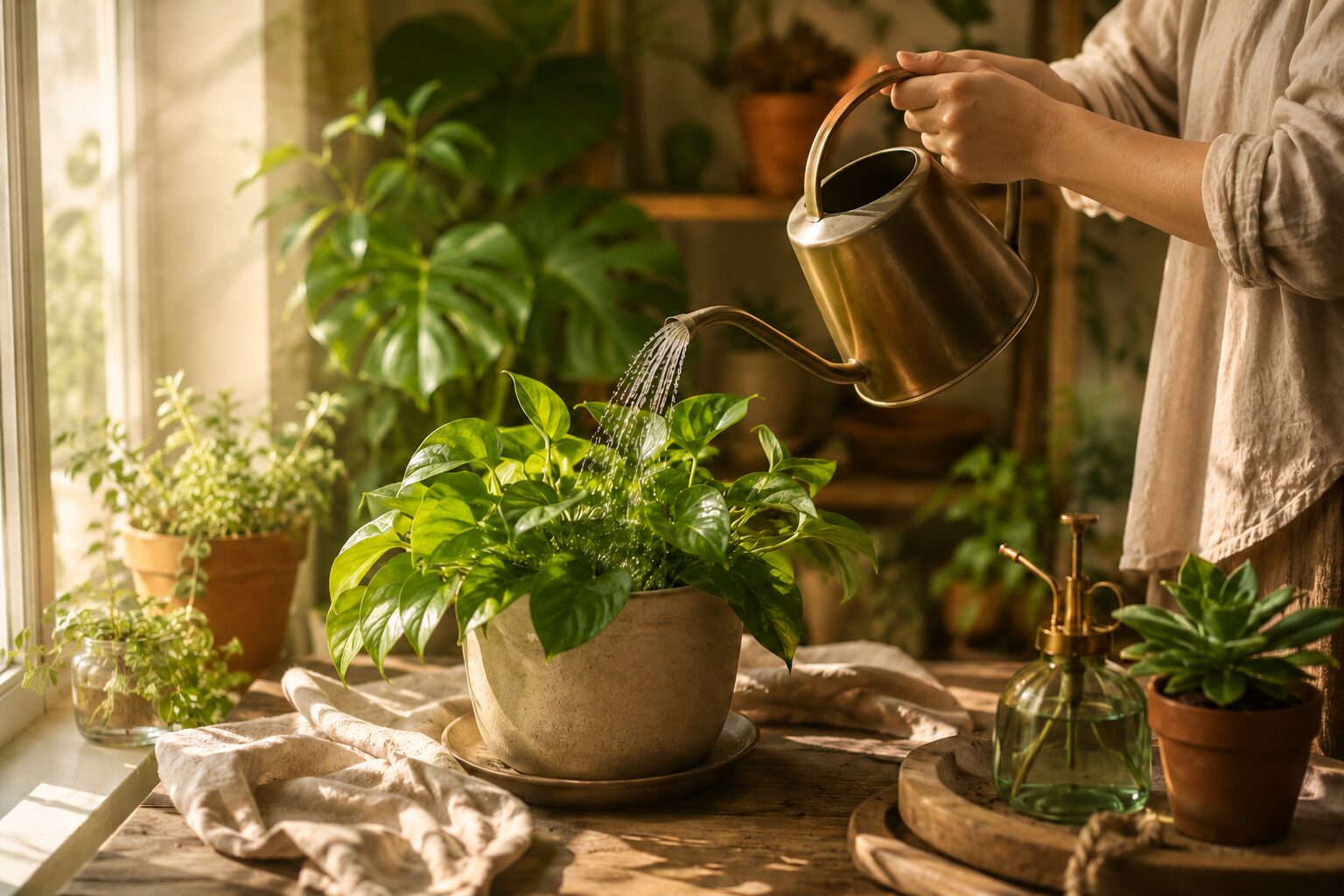
Step one: less light means less photosynthesis, which means less growth. Illinois Extension puts it plainly — houseplants in winter are “coasting,” and “they are not able to use water the way they used to.” Nebraska Extension: once light drops, “their water requirements are drastically reduced.”
Step two: a plant taking up and transpiring less water leaves the pot saturated far longer. The soil is no longer drying on the schedule you learned in summer, or in the brighter room the plant came from.
Step three: saturated soil has no air in it, and roots need oxygen. University of Maryland Extension: “excess water reduces oxygen in the soil, which damages fine roots and renders the plant unable to take up water.” The roots suffocate and begin to rot.
Step four is the trap. Iowa State Extension names it directly: roots sitting in wet soil develop rot, “this can lead to wilting, prompting you to water even more, exacerbating the problem.” A rotting plant and a thirsty plant look identical — both wilt. The instinct to reach for the watering can is exactly backwards, and it’s why, as Nebraska Extension says, “more houseplants die from overwatering than from any other cause.”
What to do instead: throw away the weekly schedule. Push a finger two inches into the soil and water only when it’s dry at that depth — for the snake plant and ZZ, only when it’s dry all the way through. In a dim room in January that might be once every three or four weeks. That’s not neglect; that’s matching the water to the light. If your pots are deep enough that a finger doesn’t reach the root zone, a soil moisture meter reads the bottom third where rot actually starts.
Stack the deck with the potting setup. Two structural fixes make overwatering much harder to do damage with. First, every pot needs a drainage hole — no exceptions, no gravel layer at the bottom instead (that raises the saturated zone rather than lowering it). A ceramic pot with a drainage hole and matching saucer is the baseline; tip out anything left standing in the saucer half an hour after watering. Second, use a chunky, well-draining houseplant mix rather than dense all-purpose soil. Bark and perlite hold air pockets open, which is precisely what roots in a slow-drying pot are short of.
Bringing a new plant home: the 4–8 week acclimation
Here’s a failure that gets misdiagnosed constantly. You buy a healthy plant, put it in the dim corner you bought it for, and three to four weeks later it drops a third of its leaves. Nothing you did that week caused it — the move did, and the delay hid the connection.
Plants build structurally different foliage for different light levels. As Missouri Extension explains, shade leaves are larger and thinner with chloroplasts spread more evenly through the leaf, and they have a lower light compensation point — the light level at which photosynthesis merely breaks even against respiration. Sun leaves dropped into a dark room sit below their compensation point: each one now costs the plant more energy than it earns. So the plant sheds them and grows shade leaves instead.
Virginia Cooperative Extension’s protocol is the fix: start a new plant in the brightest spot in your home and move it gradually to its permanent darker location over four to eight weeks. During the transition, lengthen the watering interval and cut fertilizer to about half — which reduces top growth while roots keep developing, and dovetails exactly with the watering logic above.
One buying note: commercial growers who pre-acclimate their stock under progressively heavier shade cloth produce plants that transition far better indoors. They cost more. Big-box plants pulled straight from bright production greenhouses are the ones that crash in week three.
The honest truth about “air purifying” low light plants
You’ll see nearly every plant on this list sold as an air purifier, tracing back to a 1989 NASA study. That study wasn’t fraudulent — it measured real VOC uptake. It just measured it in small sealed chambers with no air exchange, which is not a room.
In 2019, Cummings and Waring reviewed twelve published chamber studies and converted 196 experimental results into one comparable metric. Their finding: the median single plant delivers about 0.023 cubic metres of clean air per hour. To match what an ordinary building’s ventilation already does, you’d need 10 to 1,000 plants per square metre of floor space. Opening a window outperforms an entire collection.
We’d rather you hear that from us than buy a plant for a reason that doesn’t hold. The wellbeing case for houseplants — the reason a room with plants in it feels different to sit in — isn’t touched by that paper at all. That one’s real. Buy them for that.
When low light still isn’t enough
If even the plants on this list stretch, lean hard toward the window, lose variegation, or push out leaves noticeably smaller than the ones below them, your room is below what any houseplant can manage. Remember Clemson’s floor: 100 foot-candles for 12 hours a day just to hold steady.
The fix is straightforward and cheaper than replacing plants. A full-spectrum LED grow bulb screws into a normal lamp socket, throws white light rather than the purple glare of older units, and a few hours a day makes a visible difference within a month. Put it on a timer and forget it. Our complete guide to grow lights for low light plants covers formats, distance, duration, and how to tell it’s working.
Five care rules for low light houseplants
- Water by the soil, never by the calendar. Finger two inches down; dry means water, damp means wait. In a dark room in winter this can stretch to a month.
- Keep the leaves clean. Dust is a light filter, and in a room already short on light you can’t afford it. Wipe broad-leaved plants monthly with a damp cloth or plant leaf cleaning wipes. This is the highest-return five minutes in low-light plant care.
- Don’t fertilize below 200 foot-candles. Per Clemson, foliage plants show no benefit from feeding under that threshold. Feeding a dim-corner plant adds salts to soil the plant can’t use them from.
- Rotate a quarter-turn monthly. Growth follows light. Rotating keeps plants symmetrical instead of leaning permanently toward the window.
- Flush the pot every few months. Run water through until it drains freely for a minute. Essential for dracaenas, prayer plants, and spider plants, which are all sensitive to salt and fluoride buildup.
More fundamentals in our indoor plant care tips and the complete houseplant care guide.
Low light houseplant FAQ
Can any houseplant survive a room with no windows?
Not on daylight alone — no plant photosynthesizes in true darkness. But a windowless office with fluorescent or LED ceiling lighting on twelve hours a day can work for a ZZ plant, snake plant, or cast iron plant, because those fixtures often clear the 100 foot-candle floor at desk height. A room that’s dark when the lights are off and unlit most of the day needs a grow light, not a hardier plant.
Which low light plants are safe for cats?
Cast iron plant, spider plant, parlor palm, and prayer plant are ASPCA-listed non-toxic to cats and dogs. Pothos, ZZ, peace lily, Chinese evergreen, philodendron, snake plant, and dracaena are all toxic. Bird’s nest fern isn’t listed either way, so we don’t recommend it in a chewing household.
Do low light plants need less water?
Yes, and this is the single biggest adjustment people fail to make. Less light means slower growth, less transpiration, and soil that stays wet much longer. The same plant that drank weekly in a bright window may need water every three to four weeks in a dim corner. Watering it on the old schedule is the fastest route to root rot.
Why is my low light plant getting leggy?
Long bare stem between leaves — etiolation — means the plant is stretching toward light it can’t reach. It’s the clearest signal you’ve gone past tolerance into deficiency. Move it two or three feet closer to the window, add a grow light, or switch to a more shade-tolerant plant. On trailing philodendrons and pothos, pinch the stretched stems back to encourage bushier regrowth once the light improves.
Will low light plants flower?
Mostly no. The peace lily is the real exception — Clemson calls it one of the very few foliage plants that flowers in low light, though bloom timing follows a natural December–January initiation window. Parlor palms flower indoors only with adequate light. Spider plants need bright indirect light to pup reliably. Pothos never flowers in cultivation at all.
What’s the easiest low light plant for a complete beginner?
The ZZ plant, narrowly over the snake plant. Both tolerate deep shade and long droughts, but the ZZ’s rhizomes make it more forgiving of an erratic schedule and it’s less prone to crown rot from careless watering. If pets are in the picture, the cast iron plant instead — slower, but non-toxic and nearly as tough. For a broader beginner list across all light levels, see our house plant indoor guide.
Where to go next
Browse more easy indoor plants in the Houseplants hub, get watering and troubleshooting fundamentals in Plant Care, or — if your dim corner happens to be a sealed glass jar — see which species work in a closed terrarium.
Sources
- University of Missouri Extension G6515 — Lighting Indoor Houseplants
- Clemson HGIC — Indoor Plants: Light Requirements
- University of Minnesota Extension — Light Requirements for Houseplants
- NC State Extension Gardener Plant Toolbox
- Missouri Botanical Garden Plant Finder
- Virginia Cooperative Extension 426-100 — Indoor Plant Culture
- Iowa State Extension — Diagnosing Houseplant Problems
- Cummings & Waring (2020), Journal of Exposure Science & Environmental Epidemiology — Potted plants do not improve indoor air quality
- ASPCA — Toxic and Non-Toxic Plants
Get the Free Beginner’s Plant Care Cheat Sheet
Watering, light, soil, and the most common mistakes new plant parents make — delivered to your inbox. No spam, just plants.
The houseplant care kit
- Digital Illuminance Light Meter Tester 200,000Lux (18,500FC) Luxmeter — foot-candle light meter
- XLUX Plant Soil Moisture Meter, for Indoor and Outdoor use, Battery-Free — soil moisture meter
- Briignite Grow Light Bulbs, LED Grow Light Bulb A19 Bulb, Full Spectrum — full-spectrum LED grow bulb
- Craft Organic Houseplant Potting Mix, Chunky, Well Draining, Peat Free — chunky well-draining mix
- Southside Neem Oil Infused Plant Cleaning Wipes – Unscented — leaf cleaning wipes
Opens Amazon’s cart confirmation page — you review the list and prices there, and nothing is added until you approve it. Prefer to pick and choose? Every item above links to its own product page.