
Humble Acres is reader-supported. When you buy through links on our site, we may earn an affiliate commission at no extra cost to you — we only recommend products we’d use ourselves. See our affiliate disclosure.
The houseplant care kit
- Miracle-Gro Organic Indoor Potting Mix, 16 qt. — indoor potting mix
- Japanese Long Spout Watering Can for houseplant Ornamental Plants… — long-spout watering can
- Indoor Plant Food, Complete Liquid Fertilizer for Houseplants, 8oz — balanced liquid fertilizer
- Bonide Insecticidal Soap, 32 oz Ready-to-Use Spray Multi-Purpose… — insecticidal soap spray
- GREANER 12 Inch Plant Saucer, Black Plant Plates to Catch Water,… — pebble humidity tray
Opens Amazon’s cart confirmation page — you review the list and prices there, and nothing is added until you approve it. Prefer to pick and choose? Every item above links to its own product page.
Most houseplants that flower want a bright windowsill and a fussy routine. The peace lily wants neither. It blooms in the kind of dim corner where other plants merely survive, it tells you — loudly, with a full-body wilt — exactly when it is thirsty, and it forgives you the moment you fix it. Good peace lily plant care is mostly a matter of learning its few honest preferences, and this guide walks through every one of them.
Below you will find the light, water, soil, temperature, and feeding routine that university horticulturists at Clemson and NC State recommend, plus how to coax out those white sail-like blooms, which varieties fit which rooms, and an honest word about pets and children. By the end, you will know this plant well enough to keep it lush for a decade.
Meet the peace lily: not a lily at all
Here is the first surprise of peace lily plant care: the plant is not a lily. Spathiphyllum belongs to the arum family, Araceae, alongside caladiums, elephant ears, anthuriums, and calla lilies. According to Clemson Extension’s Home & Garden Information Center, the group covers dozens of species native to the tropics — Mexico, Central and South America, Malesia, and islands of the western Pacific — nearly all of them grown indoors as forgiving foliage plants.
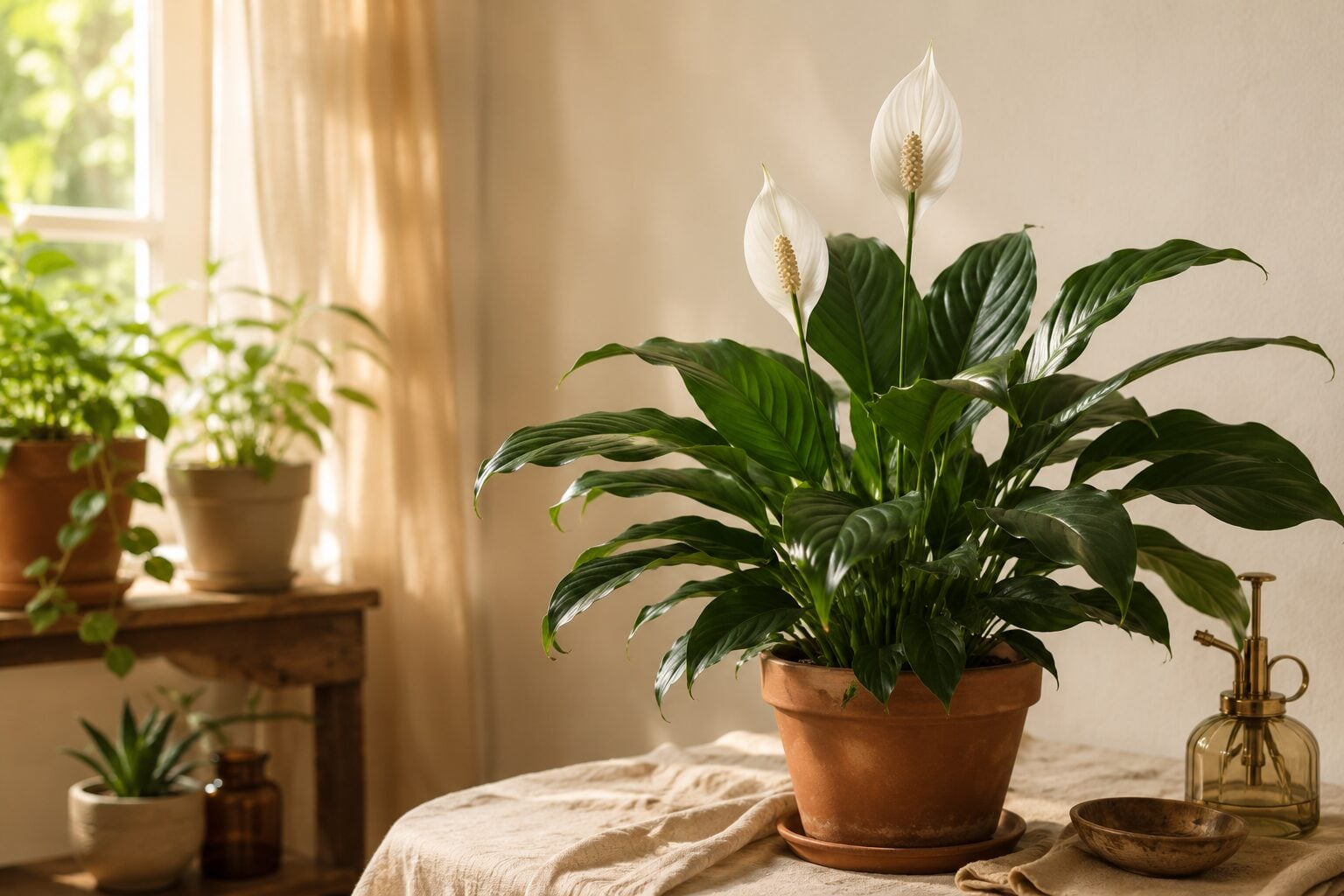
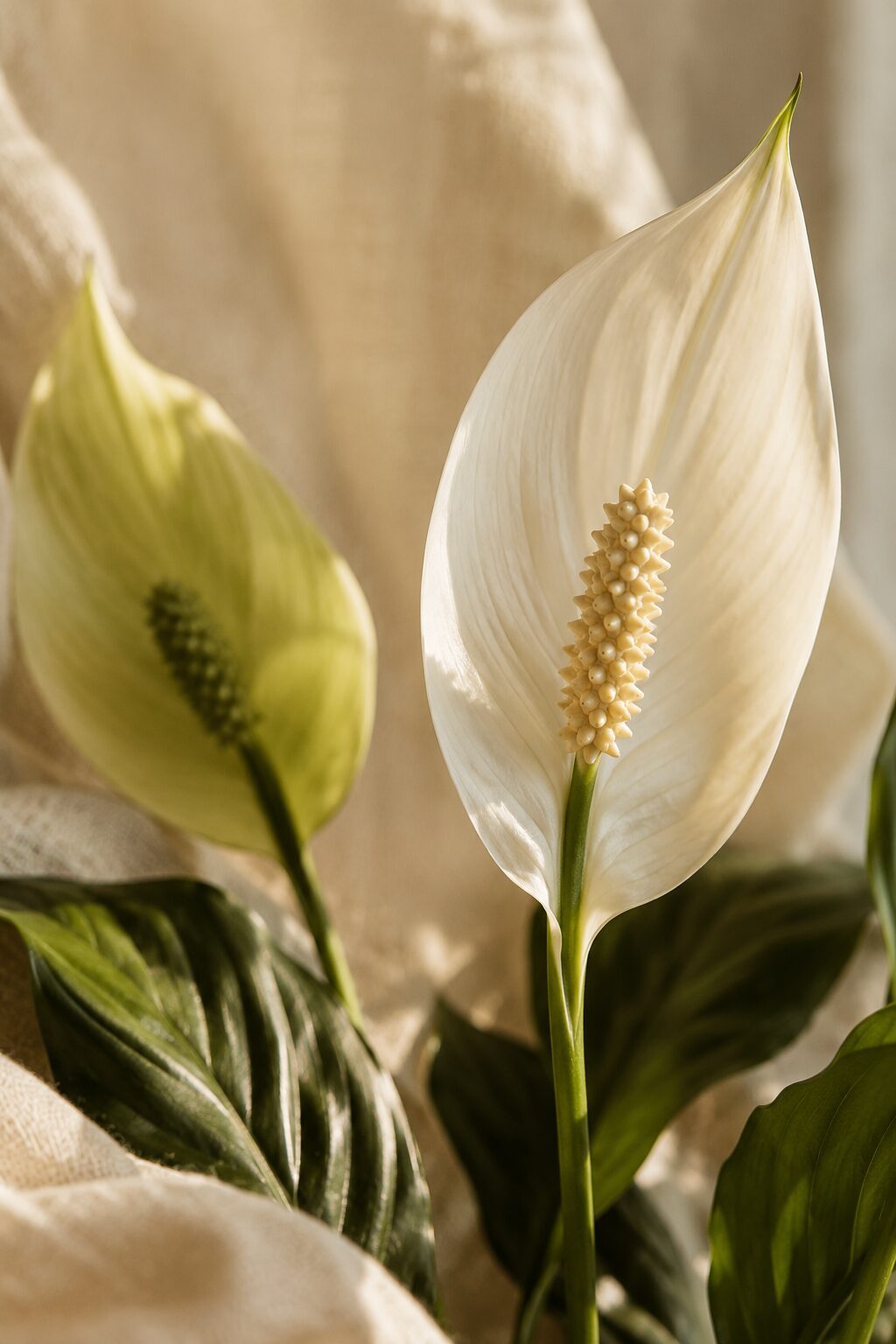
The genus name is Greek for “spathe leaf,” and that spathe is the plant’s signature: the white “flower” is actually a modified leaf, a graceful hood curved around a cream-colored central spike called the spadix. The true flowers are the tiny bumps on that spike. Glossy, dark green, oval leaves rise directly from the soil with no visible stem, forming a fountain of foliage that looks composed even when the plant is not blooming.
NC State Extension describes peace lilies as low-maintenance plants prized as specimens and accents for interior groupings — and, notably, one of the few foliage plants that will flower in low light. That single trait explains why this plant has earned a place in offices, bathrooms, and north-facing bedrooms for generations.
Peace lily plant care at a glance
| Care factor | What the plant wants |
|---|---|
| Light | Bright indirect is ideal; tolerates low light; never direct sun |
| Water | Evenly moist, never soggy; let the surface dry slightly between drinks |
| Soil | Any well-drained potting mix, ideally high in organic matter |
| Temperature | 68–85°F days, up to 10°F cooler at night; keep above 60°F |
| Feeding | Quarter-strength balanced liquid feed every 6–8 weeks, spring and summer |
| Size | Most reach 1–4 ft tall and wide; dwarfs stay near 12 in, ‘Sensation’ hits 6 ft |
| Pet safety | Toxic to cats and dogs (calcium oxalates) — keep out of reach |
Light: the low-light bloomer
Peace lilies will genuinely tolerate the dim spots that defeat most flowering plants. NC State Extension rates them for partial to deep shade, and Clemson confirms they tolerate low light while growing best in bright, indirect light. In practice, that means a few feet back from an east or north window is a sweet spot, and even a lamp-lit corner will keep the plant alive and green.
The one non-negotiable is direct sun. Hot rays through glass scorch the foliage, bleaching leaves and crisping their edges. If your only bright spot gets direct afternoon sun, hang a sheer curtain or move the plant back until the light falls soft. And remember the trade-off in the other direction: the deeper the shade, the fewer the flowers. A plant that refuses to bloom in a dark hallway is not broken — it is budgeting.
If you are working with a genuinely dark room and still want blooms, a small full-spectrum LED grow light on a timer for a few hours a day makes up the difference without changing your decor much.
Watering: moist, never soggy — and listen for the wilt
Water is where peace lily plant care differs from the succulent-style neglect that suits a snake plant. This is a tropical understory plant: it likes its soil evenly moist, allowed to dry only slightly between waterings. Clemson’s guidance is precise — keep soil moist but not soggy, water with room-temperature water, and never let the pot sit in a saucer of runoff, because standing water is the fast road to root rot.
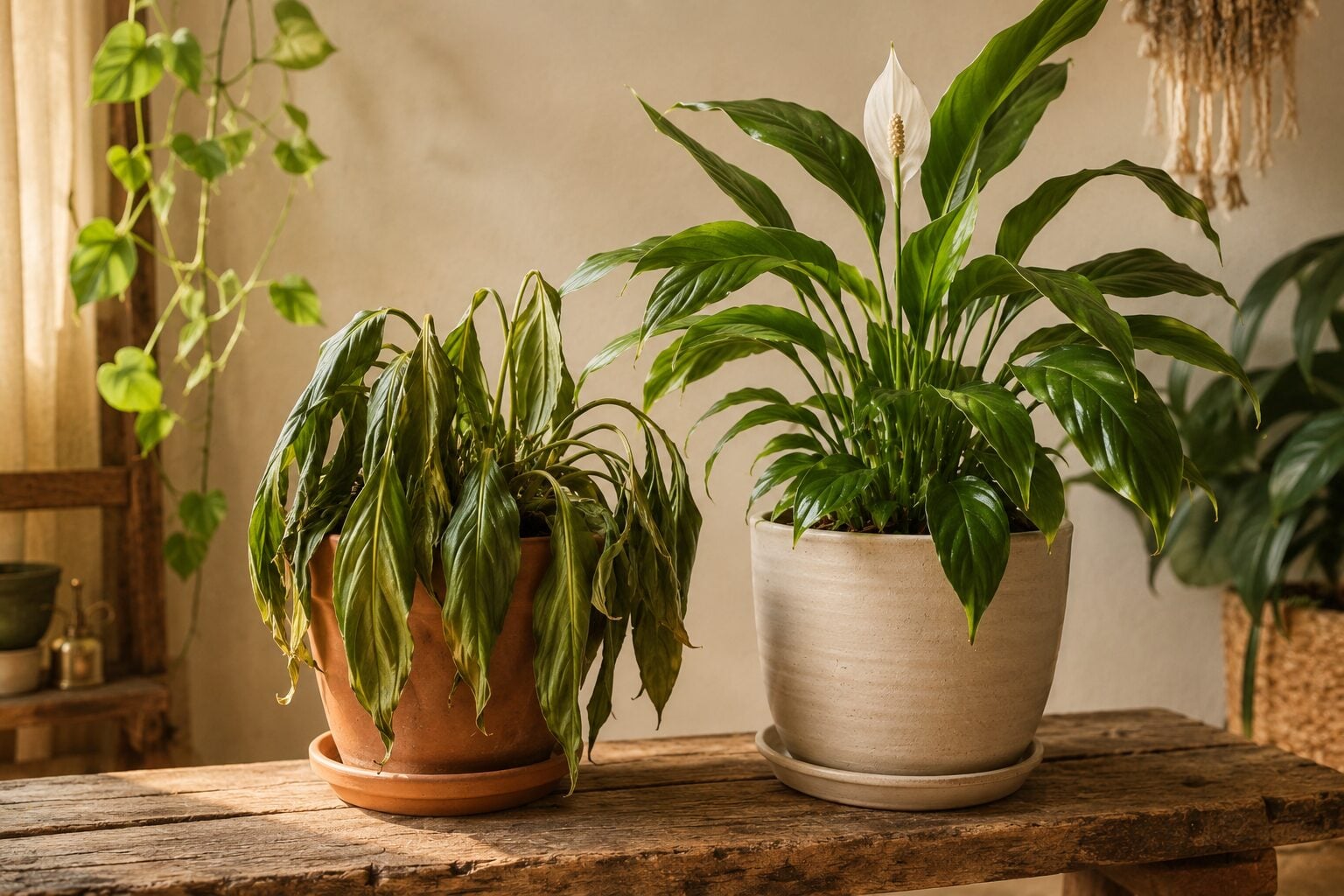
The peace lily’s party trick is that it tells you when you have waited too long. The whole plant swoons — leaves drooping in an unmistakable, theatrical wilt. Water it thoroughly and it usually rebounds within hours, standing tall as if nothing happened. Do not make the wilt your routine, though. Clemson notes that letting the soil dry out excessively turns leaves and edges yellow, and repeated droughts cost you blooms and lush growth.
A practical rhythm: check the top inch of soil with a finger twice a week. Dry at the surface but faintly damp below means water today; still moist means wait. When you water, do it generously until it drains from the bottom, then empty the saucer. A long-spout watering can makes it easy to reach the soil beneath the wide leaves instead of pouring over the foliage. NC State adds that watering from below — standing the pot in a basin for twenty minutes — works especially well for this plant.
Soil and repotting: keep it snug
Peace lilies flourish in almost any well-drained potting mix, and NC State recommends one high in organic matter — a quality indoor potting mix straight from the bag is fine. The container matters as much as the soil: drainage holes are mandatory, and the pot should be snug. This plant actually prefers life slightly pot-bound.
That preference makes repotting decisions easy. Clemson’s rule: wait until roots grow through the drainage holes or circle visibly on the soil surface, then move up just one to two inches in pot diameter. An oversized pot holds a large mass of wet soil the roots cannot drink down, which invites rot. You can repot any time of year, though the plant recovers fastest during the growing season; NC State suggests February or March, right before the spring push.
When you do repot, loosen the root ball gently so roots can find their way into the fresh mix, settle the plant at the same depth it grew before, and water it in. Division happens at the same moment: a mature clump slides apart into two or three crowns, each with roots attached, and every division becomes a new plant — the standard way to propagate a peace lily.
Temperature and humidity: think warm and steady
Peace lilies enjoy the same temperatures people do, which is part of their charm. Per NC State Extension, they thrive between 68 and 85°F during the day with no more than a 10-degree drop at night. Trouble starts at the cold end: temperatures between 40 and 60°F slow growth considerably, and extended spells below 40°F damage leaves, stems, and roots outright. Clemson draws the practical line at 60°F — keep the plant warmer than that year-round.
Just as important is steadiness. Do not park a peace lily where a heat register or air-conditioning vent blows on it, and keep it away from drafty doors and cold winter windowpanes. Hot, cold, or drafty exposures all damage the plant. Average household humidity is acceptable, though the plant appreciates more; if your air runs dry and you see brown leaf tips, cluster plants together or set the pot on a pebble humidity tray so evaporation rises around the leaves.
Feeding: less than you think
If overwatering is the classic houseplant sin, overfeeding is the peace lily’s. These plants need very little fertilizer. Clemson recommends a balanced liquid houseplant food such as 20-20-20, mixed at one-quarter of the label strength, applied every six to eight weeks during the spring and summer growing season only. Skip feeding entirely in fall and winter while growth rests.
The reason for such restraint is visible on the plant itself: overfertilizing burns the leaf tips and roots, turning them brown, and NC State warns that salt build-up does the same. Their fix is simple — flush the soil with plain water between applications of balanced liquid fertilizer, letting water run freely through the pot to carry excess salts away. Fed this lightly, a peace lily stays deep green and blooms on schedule without crispy edges.
Getting those white blooms
The flowers are why most of us bring this plant home, so it stings when a peace lily sits green and bloomless. The two usual explanations, per Clemson, are age and light: plants under a year old rarely flower, and insufficient light is the most common cause in mature plants. The cure for the first is patience; for the second, a move to brighter, still-indirect light.
When blooms do come, they are worth the wait. Peace lilies have no fixed season — NC State notes they flower freely throughout the year. Each lightly fragrant white spathe unfurls like a sail above the foliage, holds its pure white for about ten days, then ages gracefully to pale green and remains attractive for at least another month. When a spent flower finally browns, cut its stalk at the base to direct energy back into leaves and the next round of buds.
A year with your peace lily
Peace lily plant care follows a gentle seasonal rhythm. Spring is the busy season: growth resumes, so this is the moment to divide a crowded clump, repot a root-bound plant, and begin the quarter-strength feeding schedule. Watering frequency creeps up as days lengthen — expect the soil to dry noticeably faster by May than it did in February.
Summer is maintenance mode. Keep the soil evenly watered, watch that a sunny season does not swing direct rays onto the leaves as the sun’s angle changes, and enjoy the heaviest flush of blooms. Autumn is the wind-down: stop fertilizing by early fall, and expect watering to slow. Winter asks the least of you — water more sparingly, keep the plant clear of cold windowpanes and heat vents, and resist the urge to feed a resting plant. A plant that looks merely “paused” in January is doing exactly what it should, and it will answer the longer days of March with fresh leaves.
Varieties: from desktop dwarfs to six-foot statements
Decades of breeding have produced peace lilies for every room. These are the cultivars Clemson highlights, arranged small to large:
- ‘Wallisii’ — the compact classic at 12–15 inches, with rippled leaves and delicate 3-inch blooms. Perfect for desks and shelves.
- ‘Little Angel’ — a dwarf that blooms more prolifically than many older cultivars, staying 12–15 inches.
- ‘Starlight’ — shiny, tough, dark leaves on a compact 12–18 inch plant.
- ‘Jetty’ — lush glossy foliage and long-lasting white flowers at 19–24 inches.
- ‘Allison’ — around 24 inches with a famously generous flowering habit.
- ‘Domino’ — the variegated one: ruffled dark leaves speckled with white streaks, about 30 inches tall and wide.
- ‘Mauna Loa Supreme’ — the florist’s standard at 2–3 feet, with big 4-inch flowers on tall stalks.
- ‘Sensation’ — the giant, maturing at 6 feet tall and wide with ribbed, architectural foliage. A genuine floor plant that reads as an indoor shrub.
Match the mature size to the spot before you buy. A ‘Sensation’ will not stay politely on an end table, and a ‘Wallisii’ will look lost on the floor beside a sofa. If you want more foliage inspiration once you have chosen, our houseplants hub covers companions that enjoy the same warm, softly lit conditions.
Pets and children: the honest part
Every peace lily plant care guide owes you this section plainly. All parts of the plant contain insoluble calcium oxalate crystals — microscopic needles released when a leaf is chewed. The ASPCA lists the peace lily as toxic to both cats and dogs, with clinical signs that include oral irritation, burning and swelling of the mouth, tongue, and lips, excessive drooling, vomiting, and difficulty swallowing. NC State rates the poison severity as medium, and notes the same burning symptoms affect children who chew the leaves.
Two pieces of context keep this from being a dealbreaker for every household. First, the reaction is painful but very rarely life-threatening — the burning itself usually stops a pet from eating more. Second, and crucially: because a peace lily is not a true lily, it does not cause the acute kidney failure that true lilies (Lilium and Hemerocallis) inflict on cats. That said, treat it with respect. Place it on a high shelf or in a room your chewers cannot reach, and if a pet does sample it, call your veterinarian or the ASPCA Animal Poison Control Center at (888) 426-4435.
If your cat treats every shelf as a challenge, choose a pet-safe species instead — our plant care hub flags which popular houseplants are safe companions and which to keep out of reach.
Troubleshooting: brown tips, bugs, and droop
Brown leaf tips are the most common complaint, and Clemson attributes them to three causes: excessive direct sunlight, underwatering, or low humidity — with overfertilizing as the fourth suspect if edges brown broadly. Work through the list: soften the light, steady the watering, raise the humidity, and cut feeding to quarter strength. Trim damaged tips with clean scissors, following the leaf’s natural shape.
Yellow leaves usually mean the soil dried out too hard, per Clemson, though an occasional old leaf yellowing at the base is normal retirement. If leaf tissue yellows between veins that stay green, NC State points to magnesium deficiency, which can stunt the plant — a quality balanced fertilizer at the schedule above generally corrects it.
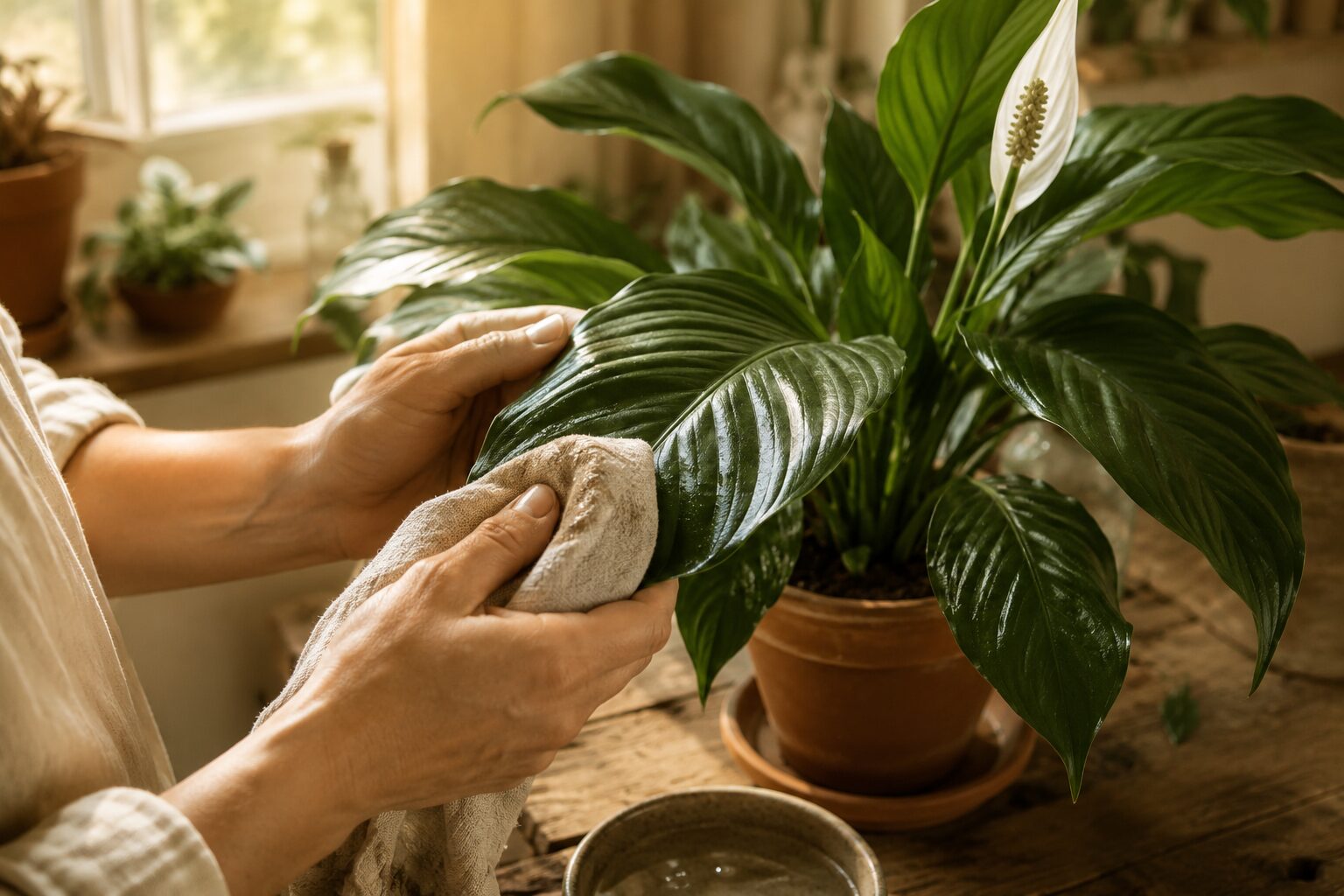
Pests are mercifully few. Mealybugs — white, cottony tufts where leaf meets stem — are the most common indoor offender, with fungus gnats, spider mites, and scale possible. Inspect leaf undersides when you water, and wipe the wide, glossy leaves regularly with a damp cloth: it removes the dust that dulls them, and evicts pests gathering underneath before they settle in. Stubborn infestations respond to insecticidal soap spray applied to all leaf surfaces weekly until clear.
Root and stem rot is the one killer, and it is almost always self-inflicted through overwatering or a saucer left full. Musty soil, blackened stem bases, and a wilt that watering does not fix are the signs. Unpot the plant, trim mushy roots back to firm white tissue, and repot in fresh, dry mix in a snug container — then water less.
A simple peace lily routine you can keep
Strip everything above down to habit and peace lily plant care takes five minutes a week. Check the soil with a finger twice weekly and water thoroughly when the surface has just dried, emptying the saucer after. Keep the plant in bright indirect light, warm and away from vents. Feed at quarter strength every six weeks or so from March through August, and flush the pot with plain water in between. Wipe the leaves monthly, glance under them for mealybugs, and repot an inch larger only when roots demand it.
Do that, and the plant rewards you the way it has rewarded beginners for a century — glossy leaves the year round and white sails rising over them, in rooms where nothing else will bloom. For the fundamentals that apply to every plant on your windowsill, from drainage to dormancy, start with the guides in our plant care library, and when you are ready to add a companion or two, the houseplants collection is full of candidates that thrive on exactly this kind of gentle neglect.
The houseplant care kit
- Miracle-Gro Organic Indoor Potting Mix, 16 qt. — indoor potting mix
- Japanese Long Spout Watering Can for houseplant Ornamental Plants… — long-spout watering can
- Indoor Plant Food, Complete Liquid Fertilizer for Houseplants, 8oz — balanced liquid fertilizer
- Bonide Insecticidal Soap, 32 oz Ready-to-Use Spray Multi-Purpose… — insecticidal soap spray
- GREANER 12 Inch Plant Saucer, Black Plant Plates to Catch Water,… — pebble humidity tray
Opens Amazon’s cart confirmation page — you review the list and prices there, and nothing is added until you approve it. Prefer to pick and choose? Every item above links to its own product page.
Leave a Reply