
Humble Acres is reader-supported. When you buy through links on our site, we may earn an affiliate commission at no extra cost to you — we only recommend products we’d use ourselves. See our affiliate disclosure.
The houseplant care kit
- Japanese Long Spout Watering Can for houseplant Ornamental Plants… — long-spout watering can
- Jxikatx Soil Moisture Meter, Plant Water Monitor Hygrometer Sensor,… — soil moisture meter
- Miracle-Gro Indoor Potting Mix for Cactus & Succulent, 8 qt. (2-Pack) — cactus and succulent potting mix
- Back to the Roots 100% Organic Perlite | Made in the USA | Premium… — perlite
- Orceler 4 Inch Terracotta Pots with Saucer – 6 Pack Small Clay Plant… — terracotta pots with drainage holes
Add all 5 to your Amazon cart →
Opens Amazon’s cart confirmation page — you review the list and prices there, and nothing is added until you approve it. Prefer to pick and choose? Every item above links to its own product page.
Snake plant watering is where almost every snake plant story goes wrong — and it’s never because someone forgot. It’s because someone cared too much. This is a plant built for drought, and the fastest way to kill one is to water it the way you’d water a fern. I’ve grown snake plants on bright sills and in dim hallway corners for years, and the honest secret is that the watering can should stay in the cupboard far more often than it comes out. This guide covers how often to water, how to do it properly when you do, and how to rescue a plant that’s already had too much — all grounded in what university horticulturists actually recommend.
Why Snake Plants Hate a Watering Schedule
Start with where this plant comes from. The NC State Extension Gardener Plant Toolbox describes Dracaena trifasciata (until recently Sansevieria trifasciata) as a succulent, evergreen perennial native to west and central Africa — a plant that shrugs off drought, dry soil, and heat. Those thick, leathery leaves are water storage tanks. In its native range, rain arrives in bursts with long dry stretches between, and the plant is built to bank each downpour and coast.
Your living room is not the problem. Your kindness is. Clemson’s Home & Garden Information Center is blunt about it: the main cause of death in potted plants is over-watering. Roots need oxygen as much as they need water, and when the potting mix stays saturated, the air pockets fill, the roots suffocate, and rot moves in. Clemson’s watering factsheet even uses the snake plant as its poster child for a plant “prone to rotting by over-watering.”
NC State puts the care requirement in one sentence: well-drained soil and careful watering are a must — do not overwater, or the roots will rot. Everything else in this guide is really just that sentence, unpacked.
How Often to Water a Snake Plant (the Honest Answer)
Here’s the answer nobody likes: there is no fixed number of days. Clemson’s horticulturists say there’s “no pat answer” to how often any houseplant needs water, because frequency depends on the plant, the pot, the mix, the light, and the season. What I can give you is the framework the extensions agree on, and it’s beautifully simple for this plant: water only when the soil is completely dry, then drench, then leave it alone.
In practice, for most homes that works out to roughly every two to four weeks during the growing season, and far less in winter. NC State’s guidance is to let the soil dry fully between waterings from spring to autumn, and in winter to water only every one to two months. Yes — months. A snake plant in a cool, dim December room genuinely wants water about as often as you pay the water bill.
Penn State Extension frames the margin of error perfectly: you can kill a snake plant by overwatering, but you can neglect one for a month or so and it will be no worse for wear. When in doubt, wait. This plant rewards procrastination like nothing else on your windowsill — it’s the same drought logic that governs succulents generally, just wrapped in taller leaves.
The Snake Plant Watering Method: Drench and Dry, Step by Step
When it is time, don’t sprinkle. Shallow sips keep the top inch damp while the root zone stays dry, and they let fertilizer salts build up in the mix. Clemson recommends watering thoroughly, every time. Here’s the full routine I use, which follows their factsheet nearly line by line:
- Check first. Confirm the mix is dry well below the surface (tests in the next section).
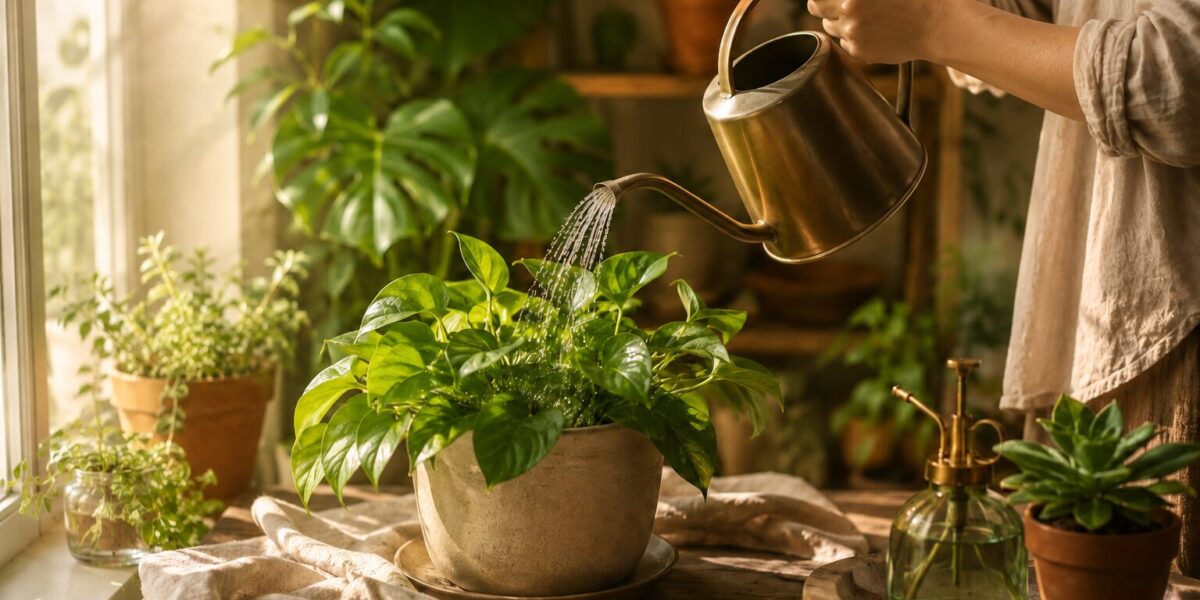
- Water slowly and evenly around the base until water runs freely from the drainage holes. A long-spout watering can gets under the leaves without soaking the crown.
- Let it drain completely. That flush wets the bottom two-thirds of the pot — where Clemson notes most of the roots live — and rinses out excess salts.
- Empty the saucer. Never let the pot stand in its own runoff. This is the step that quietly kills more snake plants than any other.
- Walk away until the mix is bone dry again.
Two water-quality notes from Clemson worth taping to the cupboard: use room-temperature water, between about 62 and 72°F — cold water shocks roots — and never use water from a household softener, which adds sodium and chloride that damage the plant over time. Plain tap water that’s sat out to reach room temperature is perfect.
How to Tell It’s Actually Time to Water
Forget calendar reminders — read the pot. Clemson’s factsheet offers four low-tech tests, and between them you’ll never guess wrong:
- The finger test. Push a finger into the mix up to the first knuckle joint. Any coolness or moisture at your fingertip means wait. For deep pots I go further with a wooden chopstick — if it comes out clean and dry like a tested cake, it’s time.
- The weight test. Lift the pot right after a proper watering and remember that heft. A dry pot feels startlingly light. This becomes second nature within a month.
- The tap test. On clay pots, rap the side with a knuckle: a dull thud means moist soil, a hollow ring means dry. Dry mix also shrinks away from the pot walls.
- The color test. Potting mix lightens noticeably as it dries — dark chocolate when moist, milk chocolate when thirsty.
What about gadgets? A soil moisture meter is a reasonable training-wheels tool, and I keep one for deep floor-standing pots. Just know Clemson’s caveat: meters vary widely in accuracy, and fertilizer and soil type can skew the readings. Trust your finger over the needle when the two disagree.
A Seasonal Snake Plant Watering Schedule
Every home is different, so treat this table as a starting rhythm, not gospel — the dry-out tests above always overrule the calendar.
| Season | Typical frequency | What’s happening |
|---|---|---|
| Spring | Every 2–3 weeks | Growth resumes; pots dry faster as light strengthens |
| Summer | Every 2–3 weeks (bright rooms), 3–4 (dim) | Peak growth and evaporation |
| Autumn | Every 3–4 weeks | Growth slows; stretch the interval as days shorten |
| Winter | Every 4–8 weeks | Near-dormant; NC State: water only every one to two months |
Clemson adds a wrinkle worth knowing: plants use less water after a flush of new growth ends or when they’re resting, so a snake plant that just finished pushing new leaves will drink slower for a while. Adjust down, not up.
What Changes the Schedule
Two identical snake plants in the same house can want water weeks apart. These are the levers, straight from Clemson’s factsheet:
- Pot material. Porous terracotta breathes and dries fast; glazed ceramic and plastic hold moisture much longer. Neither is wrong — terracotta is simply more forgiving of a heavy hand.
- Pot size. A large plant in a small pot dries quickly; a small plant swimming in a big pot stays wet dangerously long. Size the pot to the roots.
- Potting mix. Peat-heavy mixes hold far more water than gritty blends of bark, sand, and perlite. Snake plants want the gritty end of that spectrum.
- Light and warmth. A plant in a warm, bright spot needs water noticeably more often than one in a cool, dim corner — and snake plants tolerate both.
Overwatered Snake Plant: Signs and the Rescue
Root rot is the one affliction that regularly takes snake plants down — Penn State calls it the common consequence of overwatering, and NC State lists it as the plant’s main problem. The trouble is that the early symptoms are sneaky. Clemson makes a point every plant owner should memorize: the symptoms of over-watering and under-watering look alike, because both destroy roots. A wilting, wrinkling plant is not automatically thirsty — if the roots have rotted, they can’t lift water no matter how wet the soil is, and watering again makes everything worse.
So diagnose at the soil line, not the leaf tips. Warning signs of too much water: leaves yellowing from the base, a leaf that’s gone soft and mushy where it meets the soil, leaves flopping over at the base, a sour smell from the mix, or soil that stays wet for two weeks or more. If a leaf pulls free with a gentle tug and its base is brown mush, you’re past “warning” and into rescue.
The rescue, in order:
- Slide the plant out of its pot and crumble away the wet mix.
- Inspect the roots. Healthy ones are firm and pale; rotted ones are brown, slimy, and hollow. Trim every rotted root with clean scissors.
- Remove collapsed leaves at soil level — Penn State’s method for any damaged leaf — and let the bare plant sit out for a day so the cuts dry.
- Repot into fresh, dry cactus and succulent potting mix in a clean pot with drainage holes.
- Wait a week before the first light watering, then return to the full drench-and-dry rhythm.
Plants with even a few firm roots usually pull through — this species is famously hard to kill. If nothing salvageable remains below the soil, healthy leaves can be cut into sections and propagated, so the plant lives on either way. Our full snake plant care guide walks through propagation step by step.
Can You Underwater a Snake Plant?
It takes commitment, but yes. Clemson warns against letting any potting mix get excessively dry: accumulated fertilizer salts concentrate in bone-dry soil and can burn roots, and peat that dries completely turns water-repellent — it’s hard to rewet and never holds as much moisture afterward. On the plant, chronic thirst shows as wrinkled, leathery leaves that lean and curl inward, sometimes with brown tips.
The fix is Clemson’s double-watering method: water once, wait half an hour, and water again — or stand the pot in a basin of water until the surface glistens, then let it drain fully. One good rehydration and a wrinkled snake plant typically plumps back up within a week or two. It forgives you. It always does.
The Pot and Soil That Make Watering Almost Foolproof
Half of good snake plant watering happens before water ever touches the plant, on potting day. Penn State’s requirements are simple: a fast-draining mix — a bagged cactus blend, or an all-purpose mix cut generously with perlite — and a container with drainage holes, no exceptions. A cachepot with no hole is a rot machine wearing a nice outfit.
Penn State adds two practical notes I’ve learned the hard way. Choose a heavy pot for tall varieties — those dense leaves make the plant top-heavy, especially when the soil is dry, and a tall ‘Laurentii’ in a light plastic nursery pot will eventually go over. And while snake plants genuinely don’t mind being snug, a badly rootbound one can crack a clay pot from the inside. A sturdy set of terracotta pots with drainage holes solves both problems and dries the mix faster between waterings. If you’re starting fresh rather than repotting, mature plants from the Bloomscape class of growers arrive already potted in an appropriate free-draining mix.
Quick Care Stats
| Stat | Detail |
|---|---|
| Light | Bright indirect is ideal (Penn State); tolerates very low light and 2–6 hours of part-day direct sun (NC State); hot direct sun can scorch |
| Watering | Drench when fully dry: ~every 2–4 weeks in the growing season, every 1–2 months in winter (NC State) |
| Soil | Fast-draining cactus mix or potting soil amended with perlite; pot must have drainage holes |
| Humidity & temperature | Tolerates dry indoor air; fine in cool rooms to around 50°F (NC State); hardy outdoors only in zones 10–12 |
| Size & growth | Leaves up to 4 feet tall; medium growth rate, faster in brighter light |
| Feeding | Optional: half-strength all-purpose fertilizer monthly in the growing season (Penn State) |
| Pet safety | Toxic to cats, dogs, and horses (saponins); also a hazard for young children |
On that last row: NC State classifies every part of the plant — leaves, roots, sap — as poisonous if ingested, with symptoms including vomiting, nausea, diarrhea, hypersalivation, and dilated pupils in cats. Severity is rated low, but a determined leaf-chewing cat and a snake plant shouldn’t share a room. If you need pet-friendlier picks, our houseplants hub flags safe options in every guide.
Watering Through the Plant’s Life Stages
The drench-and-dry rhythm holds for an established plant, but a few moments in a snake plant’s life call for a lighter or different touch.
Right after repotting. Fresh mix plus disturbed roots is the riskiest wet-soil moment this plant ever faces. If you repotted into even slightly moist cactus mix, skip watering entirely for the first week — the roots will heal their handling nicks in dry soil instead of sitting in damp. Then give the first proper drench and resume the normal rhythm. This is the same logic behind the rescue schedule above, just gentler.
Pups and small divisions. A freshly separated pup has a small root system in a small pot, which sounds like it needs frequent water but actually dries out on its own schedule — usually faster than the mother in summer, slower in winter. Test the little pot the same way you test the big one; never water mother and pup on the same day out of habit.
Leaf cuttings in water. If you’re propagating in a jar, the “watering” job becomes water changing: refresh the jar weekly so bacteria don’t get ahead of the developing roots, and keep only the bottom inch of the cutting submerged. Once potted up, treat the new plant like a pup — and expect it to be even more sensitive to soggy mix than an adult.
New arrivals. A plant fresh from the nursery or delivery box often ships in moisture-retentive greenhouse mix. Check it before your first instinct-water; more than once I’ve unboxed a plant whose soil was already wet enough to coast for three weeks. When the first dry-out finally comes, that’s a good moment to swap it into your own gritty mix so future watering behaves predictably.
Snake Plant Watering FAQ
Should I mist my snake plant?
No. Misting wets the leaves without reaching the roots, and moisture pooled in the leaf rosette invites rot. This desert-adapted plant is happiest with dry leaves, dry air, and an occasional deep drench at the soil.
Can I bottom-water?
Yes — standing the pot in a basin until the surface darkens is essentially Clemson’s rewetting method, and it’s excellent for hydrating dried-out mix. Just top-water every few sessions anyway, since that downward flush is what rinses fertilizer salts out of the pot.
My snake plant is in a dark corner. Does that change the watering?
Dramatically. Low light means slow growth and slow drying, so a hallway plant might want water half as often as its windowsill twin. Test the soil; don’t copy the schedule. Our plant care library covers how light, water, and feeding interlock across all your plants.
Is tap water okay?
Ordinary tap water at room temperature is fine. The two to avoid, per Clemson: cold water straight from the pipe in winter, and softened water, whose sodium load builds up in the pot.
Snake plant watering, boiled down: check with your finger, water like a rainstorm when the pot is truly dry, empty the saucer, and then — the hard part — do nothing for weeks. Master that restraint and this plant will outlast your sofa.
Sources: NC State Extension Gardener Plant Toolbox — Dracaena trifasciata; Clemson HGIC 1459 — Indoor Plants: Watering; Penn State Extension — Snake Plant: A Forgiving, Low-maintenance Houseplant.
The houseplant care kit
- Japanese Long Spout Watering Can for houseplant Ornamental Plants… — long-spout watering can
- Jxikatx Soil Moisture Meter, Plant Water Monitor Hygrometer Sensor,… — soil moisture meter
- Miracle-Gro Indoor Potting Mix for Cactus & Succulent, 8 qt. (2-Pack) — cactus and succulent potting mix
- Back to the Roots 100% Organic Perlite | Made in the USA | Premium… — perlite
- Orceler 4 Inch Terracotta Pots with Saucer – 6 Pack Small Clay Plant… — terracotta pots with drainage holes
Add all 5 to your Amazon cart →
Opens Amazon’s cart confirmation page — you review the list and prices there, and nothing is added until you approve it. Prefer to pick and choose? Every item above links to its own product page.
Leave a Reply