
Humble Acres is reader-supported. When you buy through links on our site, we may earn an affiliate commission at no extra cost to you — we only recommend products we’d use ourselves. See our affiliate disclosure.
The air plant starter kit
- OWENIE White Sheer Curtains 84 inches Long 2 Panels Set, Sheer White… — sheer curtain panel
- Air Plant Variety Pack – 6 Live Tillandsia Plants (Caput Medusae,… — tillandsia variety pack
- yadoker Plant Grow Light, LED Growing Light Full Spectrum for Indoor… — full-spectrum LED grow light
- Techbee Digital Infinite Repeat Cycle Intermittent Timer Plug for… — simple outlet timer
- Fine Mist Water Spray Bottle, Misting Bottle for Plants, Plant Sprayer — misting from a fine spray bottle
Add all 5 to your Amazon cart →
Opens Amazon’s cart confirmation page — you review the list and prices there, and nothing is added until you approve it. Prefer to pick and choose? Every item above links to its own product page.
Do air plants need light? Yes — a lot more than the little glass globe on your desk suggests. Because tillandsias grow without soil, they’ve picked up a reputation as plants that live on nothing at all, and the marketing photos of air plants tucked into windowless bathrooms haven’t helped. But no soil doesn’t mean no photosynthesis. An air plant makes every bit of its food from light, and in my experience the difference between a tillandsia that limps along for a year and one that blushes, blooms, and throws pups comes down to where it sits relative to a window. This guide covers exactly how much light air plants need, which windows work, how to read the leaves, and what to do when your home is simply too dim.
The Short Answer: Bright, Indirect, Every Day
Air plants want bright light without harsh direct sun — roughly the light a fern’s canopy neighbor would get, which is exactly what they are. The University of Florida’s Gardening Solutions program recommends keeping indoor air plants near a south-, east-, or west-facing window in bright but not direct sun. Penn State Extension’s Master Gardeners narrow it further: an east or west window is the sweet spot for most species.
Here’s the test I give every spot before an air plant moves in: if you can comfortably read a book there by daylight alone for most of the day, a tillandsia can live there. If you’d reach for a lamp, the plant is reaching for one too. Dim corners, interior shelves, and windowless rooms are slow death for these plants — they may hang on for months on stored energy, which is exactly why people believe they’re fine, right up until they aren’t.
Why Light Matters So Much for an Epiphyte
To understand the light appetite, look at where these plants actually live. Tillandsia — the largest genus in the bromeliad family, with roughly 660 species by Penn State’s count — are epiphytes. In the wild they perch on tree branches and bare rock faces, gripping with wiry roots that serve as anchors and nothing more. Everything they consume arrives through their leaves: water and nutrients through the fuzzy trichome scales, and energy through ordinary photosynthesis.
Think about what a perch on a branch or a rock face means for light. These plants evolved in the bright, dappled upper world of the canopy and the open glare of cliff sides — not the dark forest floor. The UF/IFAS horticulturists note that epiphytes take nothing from their host tree; the flip side is that the atmosphere provides only water and minerals. There is no soil pantry to fall back on. Light is the whole grocery budget.
That’s also why Clemson’s Home & Garden Information Center pairs its light advice with air movement: bright light and good air circulation together mimic the breezy, sunlit perches these plants are built for. A bright spot with still, stale air is only half the habitat.
How Much Light Do Air Plants Need, Exactly?
Aim for bright, indirect light for the majority of the day — call it four to six hours of strong window light at an absolute minimum, with more being better for color and blooms. “Indirect” is the operative word indoors: light bounced or filtered near a window, rather than a beam of sun resting on the leaves for hours.
A little gentle direct sun is fine and often helpful — early morning rays through an east window are mild enough for nearly every species. What tillandsias can’t take is hot midday or afternoon sun magnified through glass. Penn State warns that direct sun scorches air plants quickly outdoors; behind a window, glass concentrates the heat and the plant can’t shed it. My rule of thumb: touch the leaves on a sunny afternoon. If they feel warm, the plant is too close to the glass — slide it back a few feet or hang a sheer curtain panel to break the beam.
The Window-by-Window Guide
Every home hands you a different set of windows, so here’s how each exposure treats an air plant, following the UF/IFAS south-east-west guidance:
- East windows — the gold standard. Gentle direct sun in the cool morning hours, bright shade the rest of the day. Set plants right on the sill.
- West windows — excellent light, but the direct sun arrives in the afternoon when it’s hottest. Keep plants a few feet back from the glass or filter with a sheer curtain.
- South windows — the brightest option and UF/IFAS approves them, but treat them with respect: a few feet back from the glass, or curtain-filtered, so plants get the glow without hours of beam. The silvery, fuzzy species handle a south exposure best.
- North windows — usually too dim as a permanent home. A tillandsia will survive a while but slowly fade, stop blooming, and stay wet too long after watering. If north light is all you have, plan on a grow light.
Distance matters as much as direction. Light intensity falls off dramatically with every foot you move into a room — the difference between a windowsill and a shelf eight feet away is far bigger than it looks to our eyes. When in doubt, closer to the glass (minus the hot beam) is almost always the right call.
Silver vs. Green: Your Air Plant Tells You What It Can Handle
Not all tillandsias want identical light, and wonderfully, the plant wears its preference on its leaves. Penn State’s Master Gardeners divide the genus into two camps, and once you know them you can place any air plant on sight.
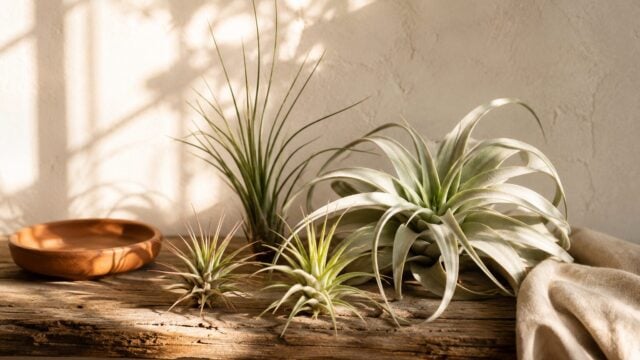
Xeric species come from deserts and exposed rock. Their leaves are wide, gray-silver, and thickly felted with trichomes — that fuzz is sun armor as much as drought armor, reflecting excess light and trapping dew. Species like the sculptural T. xerographica tolerate the most light of the family, including some acclimated direct sun. If your only bright spot is a fierce south window, choose from this camp.
Mesic species hail from humid rainforest, where light arrives filtered through leaves. Penn State describes them as deeper green, smoother, and slightly cupped, with smaller trichomes. Think T. bulbosa and T. butzii. These want bright shade and gentler exposure — an east window or a spot set back from stronger glass.
The rule of thumb from our full care of airplants guide holds here: the grayer and fuzzier the plant, the more sun and less water it wants; the greener and smoother, the more water and less sun. A mixed tillandsia variety pack is a great way to learn this firsthand — spread the plants across two or three spots and watch which ones color up where. Etsy’s specialist air plant shops are another good source for named species once you know your light.
Do Air Plants Need Light to Bloom?
Emphatically yes — light is the single biggest lever you have over flowering. Penn State notes that a tillandsia blooms once in its lifetime, and that maximum light (alongside steady water and a little fertilizer) is what encourages the show. UF/IFAS adds that indoor blooms tend to arrive in late winter or mid-summer and can last anywhere from days to months depending on species.
The bloom sequence is worth the wait: many species blush red or coral at the crown first, then send up a flower spike in violet, pink, or yellow. Afterward, the mother plant slowly declines while producing pups around her base — the next generation. An air plant that has sat green and unchanged for two years isn’t necessarily unhealthy, but it’s almost certainly under-lit. Move it brighter and feed it, and you’ll often see a blush within a season. Blooming plants have one special rule: never soak the flower itself — dunk the leaves and keep the spike dry.
Signs Your Air Plant Needs More Light
Under-lighting is the quiet chronic ailment of indoor tillandsias, and it looks like this:
- Fading, dull color — the plant loses its vibrancy and silvery species go flat gray-green. (Clemson notes dull color can also mean thirst, so check your watering rhythm at the same time.)
- Stretched, floppy growth — new leaves come in longer, thinner, and weaker as the plant reaches for light.
- No blush, no bloom, no pups — year after year of green stasis.
- Staying wet too long — a dim, still spot slows drying after watering, and Clemson’s factsheet is clear that trapped moisture is how air plants rot. Slow drying in a dark corner is a double hazard: weak plant, wet base.
The fix costs nothing: move the plant closer to a brighter window and give it a few weeks. Air plants respond to a light upgrade faster than almost any change you can make.
Signs of Too Much Light
Overexposure announces itself faster and more dramatically. Watch for crispy brown or bleached patches on the sun-facing side — that’s scorch, and Penn State warns it can happen quickly in direct sun, especially outdoors in the afternoon. You’ll also see the whole plant drying to a crisp days faster than usual; UF/IFAS flags curled or rolled leaves as the classic dehydration signal, and strong sun accelerates exactly that.
Scorched tissue doesn’t heal — the plant has to grow past it. Move an overexposed plant into bright shade, step up the soaking rhythm for a few weeks, and trim the worst crisped tips with clean scissors at an angle if the look bothers you. Then reintroduce any direct sun gradually, morning rays first.
Grow Lights: The Dim-Home Solution
If your apartment faces an airshaft or your only free surface is an interior bookshelf, you’re not out of the air plant game — you just need to bring the sun indoors. A small full-spectrum LED grow light clipped above the display solves a dim room completely, and modern LEDs sip electricity and run cool.
My working setup for a lightless hallway shelf: the fixture about a foot and a half above the plants, running twelve hours a day on a simple outlet timer to mimic a tropical day length. Consistency beats intensity — a reliable twelve hours daily grows a better plant than occasional blasts. Ordinary room lamps and ceiling fixtures, for the record, are rarely strong enough unless the plant sits within arm’s reach of the bulb; if the setup doubles as your reading light, it’s probably close enough.
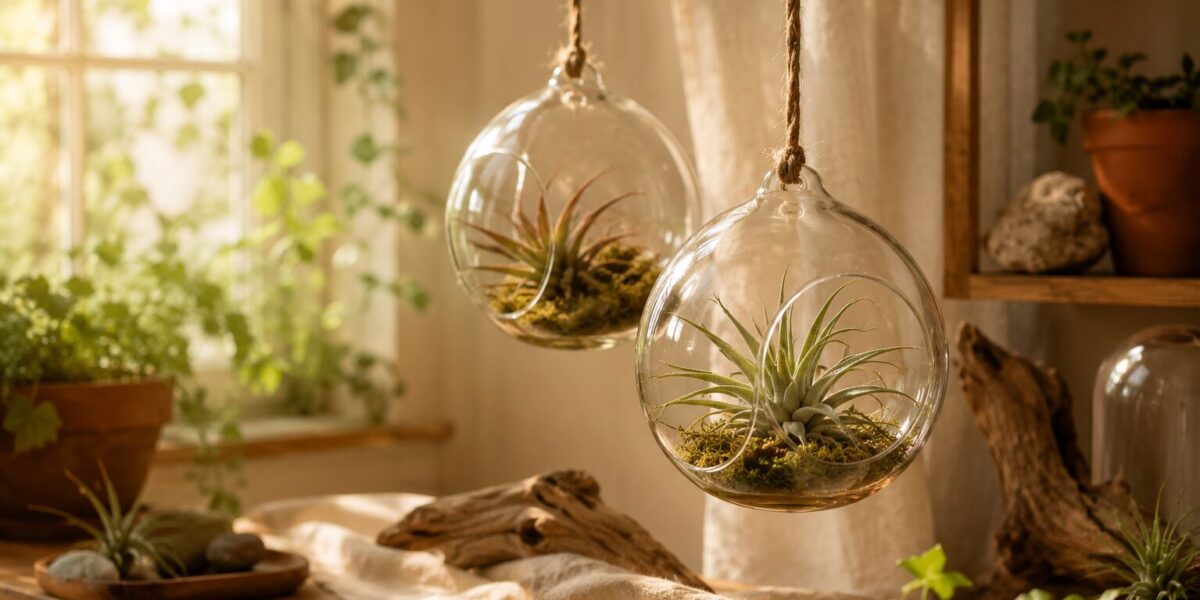
Grow lights also rescue the classic terrarium problem: glass globes and vessels displayed deep in a room, far from any window. Light the display properly and the glass becomes an asset instead of a dim little greenhouse — our terrarium guides cover open-vessel display safely, including the drying rules that keep glass-housed air plants rot-free.
Summering Outdoors: The Bright-Shade Vacation
The best light most air plants will ever get indoors-adjacent is a summer outside. Penn State’s advice: hang them under a tree canopy or on a covered porch in bright shade, where they’ll enjoy real sun intensity, rain, and moving air — and reward you with their best growth of the year. Keep them out of direct afternoon sun, which scorches fast outdoors.
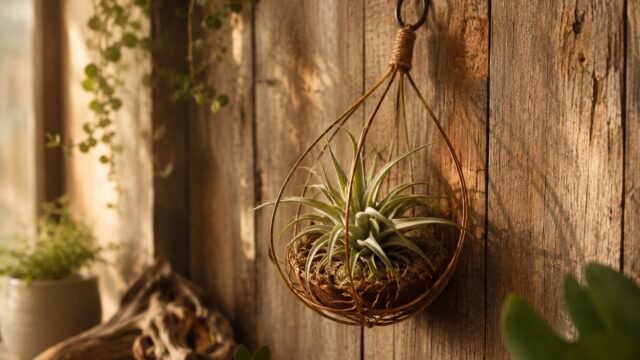
Temperature sets the calendar. Penn State pegs the comfort zone at 65–90°F days with nights above 55°F, so move plants out after nights reliably clear the mid-50s and bring them back in as autumn nights cool. A shaded porch rail, a tree branch with plants wired on, or a hanging basket frame all work — anywhere bright, airy, and rain-washed but out of the beam.
More Light Means More Water
One rhythm change catches people out after a light upgrade: brighter plants drink more. Light drives growth and warmth drives evaporation, so a tillandsia moved from a dim shelf to a sunny window may need to go from a leisurely soak schedule to the full weekly program — Clemson’s baseline of a 20–30 minute weekly submersion, shaken out and dried upside down, with misting from a fine spray bottle between soaks in dry rooms, per Penn State’s every-other-day guidance for parched homes.
The reverse also holds: a plant in modest light needs less water, and overwatering a dim-kept air plant is the fastest way to rot it. Light and water are two ends of the same dial — turn them together. The broader version of that principle, for every plant on your sill, lives in our plant care library.
Don’t Forget the Winter Light Drop
One last seasonal wrinkle: the window that was perfect in June can be marginal in January. Winter sun sits lower, days shorten by hours, and the same sill may deliver half the light it did in summer. If your air plant fades or stalls as the days shorten, that’s not a mystery ailment — it’s the light budget shrinking.
The winter playbook is simple. Move plants to your brightest window for the season — a south exposure that was too fierce in July is often ideal in December, when the sun is weaker and lower. Clean the glass; a season of grime steals a surprising share of the light. And if the fade continues, let a grow light carry the plants until spring, then migrate them back to their summer spots. Rotate each plant a quarter-turn at watering time year-round so it colors evenly instead of leaning toward the glass.
Safe for Curious Pets
Good news if your windowsills are contested territory: the ASPCA lists Tillandsia as non-toxic to cats and dogs, making air plants one of the safest choices for bright, pet-trafficked windows. A chewed plant may cause mild tummy upset and will look worse than the cat feels. The genuine hazards are the accessories — mounting wire, glue dots, and decorative pebbles — so keep hardware snug and displays out of batting range. More pet-conscious picks live on our air plants hub.
Air Plant Light FAQ
Can an air plant live in a windowless bathroom?
Not on room light alone. The shower humidity is pleasant for a mesic species, but without a window or a grow light there’s no energy source, and the plant will slowly starve over some months. Add a small full-spectrum bulb in the vanity fixture on a daily timer and the bathroom becomes genuinely good habitat.
How many hours of light per day?
Bright light for most of the day is the goal — treat four to six hours of strong indirect window light as the floor, not the target. Under a grow light, run about twelve hours daily to compensate for the lower intensity.
Can air plants take full sun?
A few silvery xeric species can handle gentle direct sun, morning rays especially, if acclimated gradually. No tillandsia enjoys hot afternoon sun through glass, and Penn State cautions that outdoor direct sun scorches them quickly. When in doubt, bright shade.
Is a north-facing office desk hopeless?
With a window nearby, marginal; the plant survives but won’t thrive or bloom. A clip-on grow light turns the same desk into prime real estate for a few dollars a year in electricity.
So — do air plants need light? As much as any plant you own, and more than most of the places we’re tempted to put them. Give a tillandsia a bright east window or an honest grow light, pair the light with the matching water rhythm, and the plant that “does nothing” will blush, flower, and multiply on your sill.
Sources: Penn State Extension — Tillandsias as Houseplants; UF/IFAS Gardening Solutions — Air Plants; Clemson HGIC 1515 — Air Plants; ASPCA Toxic and Non-Toxic Plant List.
The air plant starter kit
- OWENIE White Sheer Curtains 84 inches Long 2 Panels Set, Sheer White… — sheer curtain panel
- Air Plant Variety Pack – 6 Live Tillandsia Plants (Caput Medusae,… — tillandsia variety pack
- yadoker Plant Grow Light, LED Growing Light Full Spectrum for Indoor… — full-spectrum LED grow light
- Techbee Digital Infinite Repeat Cycle Intermittent Timer Plug for… — simple outlet timer
- Fine Mist Water Spray Bottle, Misting Bottle for Plants, Plant Sprayer — misting from a fine spray bottle
Add all 5 to your Amazon cart →
Opens Amazon’s cart confirmation page — you review the list and prices there, and nothing is added until you approve it. Prefer to pick and choose? Every item above links to its own product page.
Leave a Reply