
Humble Acres is reader-supported. As an Amazon Associate we earn from qualifying purchases — at no extra cost to you. See our affiliate disclosure.
The houseplant care kit
- Fosmon Digital Timer for Electrical Outlets, Indoor 24 Hour Light… — 24 hour plug-in light timer for grow…
- Orceler 4 Inch Terracotta Pots with Saucer – 6 Pack Small Clay Plant… — terracotta pots with drainage holes
- LED Grow Light Strips, Grow Lights for Indoor Plants Full Spectrum… — full spectrum LED grow light bar for…
- Miracle-Gro Indoor Potting Mix for All Plants, 16 qt. — indoor potting mix for houseplants
Opens Amazon’s cart confirmation page — you review the list and prices there, and nothing is added until you approve it. Prefer to pick and choose? Every item above links to its own product page.
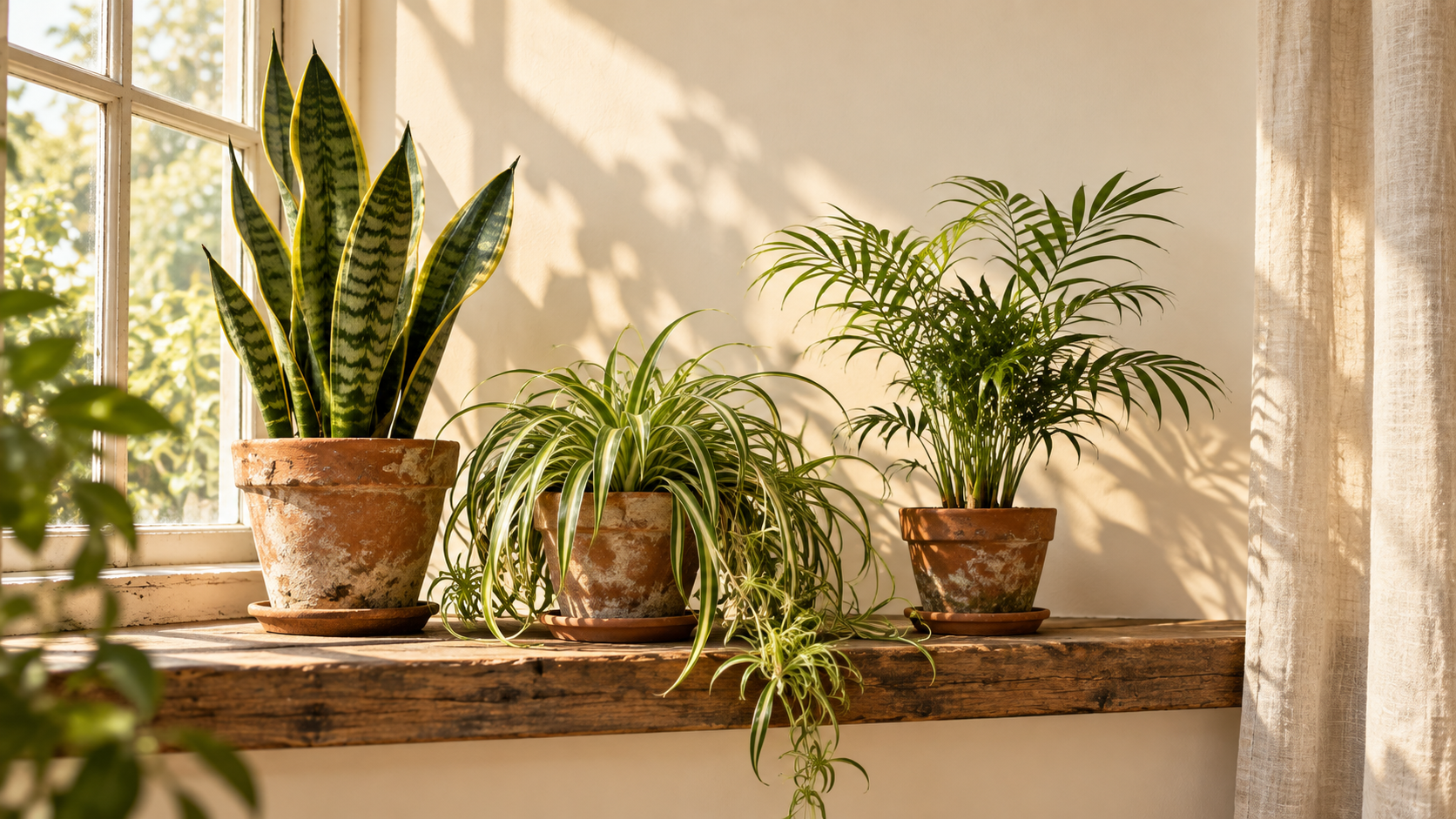
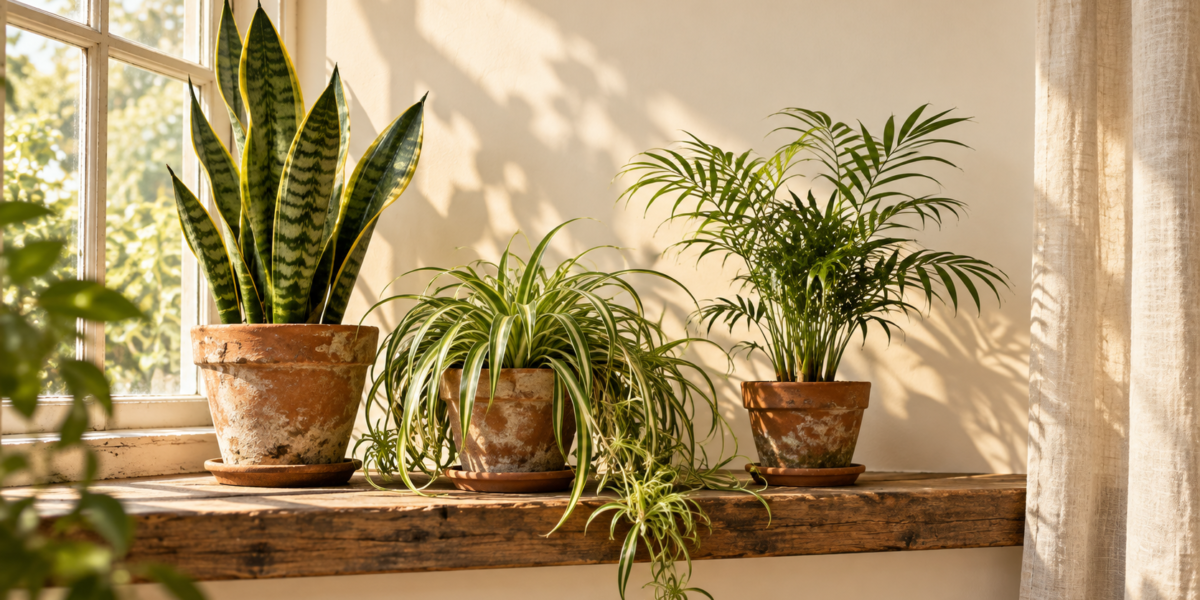
Every list of air purifying plants you have ever read traces back to the same 1989 experiment, and almost none of them mention that the experiment took place inside a sealed plexiglass box roughly the size of a laundry hamper. That detail matters more than any ranking. It is the difference between a plant that scrubs a chamber and a plant that sits in your living room doing something much smaller and much more human.
I still keep every plant on the list below. I just keep them for honest reasons now. So this guide does two things at once: it tells you exactly what the research shows and does not show, and then it gives you the twelve plants worth owning anyway — with the light they need, the water they want, and, for every single one, whether the ASPCA considers it safe around a cat or a dog. That last column is where most roundups quietly fail their readers.
The 12 best air purifying plants at a glance
All twelve appear on the UConn Home & Garden Education Center list drawn from the original NASA research. Light categories follow University of Missouri Extension guide G6515, which sorts indoor plants into low light (50–250 foot-candles), medium light (250–1,000 foot-candles) and high light (1,000+). Pet status is straight from the ASPCA.
| Plant | Light | Water | Pets (ASPCA) | Difficulty |
|---|---|---|---|---|
| Snake plant (Dracaena trifasciata) | Low to bright | Sparse — let it dry | Toxic | Very easy |
| Golden pothos (Epipremnum aureum) | Low to medium | Dry between | Toxic | Very easy |
| Spider plant (Chlorophytum comosum) | Medium; tolerates shade | Evenly moist | Non-toxic | Very easy |
| Peace lily (Spathiphyllum) | Low; medium to bloom | Never bone dry | Toxic | Easy |
| Janet Craig dracaena | Low to medium | Evenly moist | Toxic | Easy |
| Red-edged dracaena (D. marginata) | Low to medium | Evenly moist | Toxic | Easy |
| Heartleaf philodendron | Low to medium | Uniformly moist | Toxic | Very easy |
| Boston fern (Nephrolepis exaltata) | Medium | Constantly moist | Non-toxic | Fussy |
| Areca palm (Dypsis lutescens) | Medium | Uniform, slight drying | Non-toxic | Moderate |
| Parlor / bamboo palm (Chamaedorea) | Low to medium | Uniform | Non-toxic | Easy |
| English ivy (Hedera helix) | Medium to bright | Constant moisture | Toxic | Moderate |
| Chinese evergreen (Aglaonema) | Very low tolerant | Moderate | Toxic | Very easy |
Read that pet column again before you shop. Eight of the twelve are toxic. The overlap between “famous air purifying plants” and “safe with a curious cat” is much smaller than the internet implies, and we come back to it in detail further down.
What the NASA study actually found — and what it did not
In the late 1980s, NASA scientists working with the Associated Landscape Contractors of America tested nineteen common houseplants against three indoor pollutants: formaldehyde, benzene and trichloroethylene. The work was led by B.C. Wolverton at the John C. Stennis Space Center, and the goal was never your apartment. It was life support for sealed spacecraft.
The results were real. UConn’s extension summary records that Warneck dracaena removed 50 percent of the formaldehyde in a chamber over twenty-four hours, though only 10 percent of the trichloroethylene. A chrysanthemum took out 61 percent of the formaldehyde and 41.2 percent of the TCE in the same test. Those are genuine numbers from a genuine experiment.
The chambers, though, were 30-by-30-by-30-inch plexiglass cubes — and some twice that volume. Sealed. No ventilation. No furniture off-gassing all day. No door opening. A room is none of those things, and that gap is the entire story of the last thirty-five years of this claim.
One finding from the same body of work deserves more attention than it gets: a separate two-year NASA study found that when the same plants and their potting soil were exposed continuously to benzene-laden air, their cleaning capacity improved over time. The suggestion is that soil microorganisms adapt. The roots and the mix are doing at least as much work as the leaves — which is one reason a plant sitting in tired, compacted soil is not the plant that was tested.
NASA’s own dosing recommendation, repeated by UConn, was one healthy plant in a 6-to-8-inch container per 100 square feet of living space. Hold onto that number. It is about to get contradicted by a much bigger analysis.
The 2019 study that changed the answer
In November 2019, Bryan Cummings and Michael Waring at Drexel University published “Potted plants do not improve indoor air quality” in the Journal of Exposure Science & Environmental Epidemiology. They did something no previous paper had done: they made the chamber studies comparable to real air cleaners.
They reviewed twelve published chamber studies and converted 196 individual experimental results into clean air delivery rate — CADR, measured in cubic metres per hour. CADR is the standard yardstick for air purifiers, so putting plants on that scale finally allowed an apples-to-apples comparison against ordinary ventilation.
The median single-plant CADR came out at 0.023 m³/h. To match the volatile organic compound removal that outdoor-to-indoor air exchange already provides in a typical building — around one air change per hour — you would need somewhere between 10 and 1,000 plants per square metre of floor space. Not per room. Per square metre.
As Drexel put it, the rate at which plants dissipate VOCs in a chamber is orders of magnitude slower than the ordinary air exchange of a building. The plant’s net effect on the air you are breathing right now is, in practical terms, nothing. The American Lung Association reached the same conclusion for the same reason.
None of this makes the plants bad. It makes the marketing bad. And knowing the difference is what lets you buy well instead of buying a story.
So what actually cleans your indoor air
The EPA gives three strategies, in order of effectiveness, and it is worth memorising them because they are cheap and they work.
Source control comes first. Remove or reduce whatever is emitting: unvented combustion, solvents and paints, heavily fragranced products, damp materials growing mould. The EPA notes this is usually both the most effective approach and the most cost-efficient, since cranking up ventilation also cranks up your energy bill.
Ventilation is second. Open a window. Run the window or attic fan. Open the vent control on a window air conditioner. Use the kitchen and bathroom exhaust fans that actually vent outdoors — they pull contaminants straight out of the room where they are made.
Filtration is third. A portable air cleaner or a better furnace filter captures what is left. The EPA is explicit that filtration supplements the first two strategies rather than replacing them. If particulates are your real concern — smoke, dander, pollen — this is the purchase that changes your air.
HEPA air purifier for large room
Buy the plants for the reasons plants are actually good: they are beautiful, they give a room life, and the documented benefits — lower reported stress, better mood, higher perceived comfort — are psychological and well worth having. Just do not ask a pothos to do a filter’s job.
How to choose air purifying plants for your actual room
The single biggest predictor of whether a plant survives you is whether its light needs match your window. Missouri Extension is blunt about the numbers: low-light plants want 50–250 foot-candles, medium-light plants want 250–1,000 with best growth above 750, and high-light plants need 1,000 or more and are generally poor candidates indoors.
More usefully, the same guide notes that even low-light plants usually do not get enough light more than ten feet from an average window. South windows are brightest for the longest. East and west windows suit the medium-light group. North windows work only for the genuinely shade-tolerant — Chinese evergreen, parlor palm, snake plant, pothos.
Your plant will tell you when it is short of light before it dies of it. Missouri Extension lists the signals: stretched internodes, leaves smaller than they should be, pale green stems and foliage, and lower leaves yellowing and dropping. If you are seeing three of those four, move the plant or add a light. Our guide to the best low light houseplants goes deeper on which species genuinely cope with a dim corner.
One more thing from UConn that almost nobody does: wipe the leaves. Dust on foliage reduces the gas exchange and the light reaching the leaf surface. A damp cloth, or a rinse in the sink every month or two, keeps a plant working properly. A healthy plant outperforms a struggling one at everything — including the modest things it really can do.
The 12 plants, one by one
1. Snake plant (Dracaena trifasciata)
The most forgiving plant on this list. Missouri Extension notes it tolerates poor light but makes its best growth in medium to bright conditions, and warns specifically against overwatering — the one thing that reliably kills it. UConn’s table also flags it as a night oxygen emitter, a CAM plant that keeps its stomata open after dark. Real, but a trivial quantity in a bedroom. ASPCA: toxic to cats and dogs via saponins, usually mild stomach upset. Our full snake plant care guide covers watering cadence and propagation.
2. Golden pothos (Epipremnum aureum)
Satisfactory in low and medium light, and less demanding about even moisture than a philodendron. It trails, it roots in water, and it forgives a missed week. ASPCA: toxic — insoluble calcium oxalates that cause mouth and throat irritation when chewed.
3. Spider plant (Chlorophytum comosum)
The best all-round pick if you have pets. Clemson HGIC reports it prefers medium light, tolerates deep shade, and is intolerant of direct sun. It wants moist soil and medium humidity but shrugs off drought. Two specific cautions: chlorinated or fluoridated tap water causes leaf tip burn, so let water stand overnight or use distilled; and do not over-fertilise, because it suppresses plantlet formation. Keep it above 45°F. Plantlets form when the mother plant gets under twelve hours of light a day for at least three weeks, then root readily on contact with soil. ASPCA: non-toxic.
4. Peace lily (Spathiphyllum)
Adapts to low light but needs medium light to actually flower, and it must never dry out — it wilts dramatically and holds a grudge. ASPCA: toxic, insoluble calcium oxalates. See our peace lily plant care guide for the bloom cycle and the honest pet conversation.
5 & 6. Janet Craig and red-edged dracaena
Both tolerate low light and do well in medium. Missouri Extension notes dracaenas need to be kept warm and constantly moist for best growth, and most eventually become large plants — plan the ceiling height. ASPCA: toxic, saponins, moderately so.
7. Heartleaf philodendron
Tolerates low light, prefers medium, wants fairly uniform moisture. Nearly as indestructible as pothos and easier to shape. ASPCA: toxic, insoluble calcium oxalates.
8. Boston fern (Nephrolepis exaltata)
Tolerates low light but prefers a medium level, and wants to be kept cool and moist. It browns at the leaflet tips when humidity drops, which is why it fails in heated winter rooms. Bathroom, north window, weekly attention. ASPCA: non-toxic.
9. Areca palm (Dypsis lutescens)
Best in medium light. Prefers fairly uniform moisture with occasional slight drying, and grows slowly indoors. Watch for spider mites, which Missouri Extension calls out for palms specifically — check the undersides of the fronds monthly. ASPCA: non-toxic.
10. Parlor palm and bamboo palm (Chamaedorea)
The most low-light-tolerant palms in the guide, and the ones most likely to survive an interior corner. Uniform moisture, no direct sun, slow growth. ASPCA: non-toxic.
11. English ivy (Hedera helix)
Grows best in medium to bright light and needs constant moisture or it drops leaves. It prefers to be kept slightly cool indoors. ASPCA: toxic — vomiting, abdominal pain, hypersalivation and diarrhoea, with the foliage more toxic than the berries. Trailing plant plus curious cat is a bad combination.
12. Chinese evergreen (Aglaonema)
Missouri Extension says it tolerates light as low as ten foot-candles, which makes it the most shade-tolerant plant on this list by a wide margin. Handsome variegation, minimal demands. ASPCA: toxic.
The best air purifying plants if you have cats or dogs
Here is the overlap nobody puts in a headline. Of the classic list — snake plant, pothos, peace lily, every dracaena, the philodendrons, English ivy — the majority are ASPCA-listed as toxic. That does not make them unusable. It makes placement a real decision rather than an afterthought.
The genuinely pet-safe subset of the twelve is short and useful: spider plant, Boston fern, areca palm, parlor palm and bamboo palm. All five are ASPCA non-toxic, and all five appear on the same NASA-derived list as the toxic ones. If you want air purifying house plants and a cat in the same room, build around those.
Two practical notes. “Non-toxic” means it will not poison a pet, not that a pet should eat it — any plant material can cause vomiting in quantity. And most houseplant exposures produce mild, self-limiting stomach upset; the ASPCA toxic and non-toxic plant list is the source to check before you buy, and the Animal Poison Control Center at 888-426-4435 is the number to call if something gets chewed.
Height beats hope. A hanging spider plant and a shelf-mounted fern solve more problems than any amount of training. Our cat safe plants guide has the full non-toxic list if pets are your main constraint.
Care that keeps them alive
If your room genuinely lacks light, supplemental lighting is the fix — and Missouri Extension gives usable numbers rather than vibes. Plants receiving no natural light want 16 to 18 hours a day. Plants getting some daylight want 12 to 14. Critically, run the lights during daylight hours; adding light at the ends of the day is less effective than reinforcing the natural period.
Keep the tips of the plant 6 to 12 inches from a fluorescent source. Budget 10–15 watts of fluorescent per square foot for low-light plants and 15 or more for medium-light plants. Light intensity falls away fast with distance, so a fixture two feet up is doing a fraction of the work you think it is.
full spectrum LED grow light bar for indoor plants
Consistency matters more than intensity, which is why a 24 hour plug-in light timer for grow lights is the cheapest upgrade in this whole article. Missouri Extension recommends one outright, and adds a safety note worth repeating: ground the fixture, because watering cans and electrical cords share a shelf.
The rest is unglamorous. Repot before the roots circle the pot, using indoor potting mix for houseplants rather than garden soil, and choose terracotta pots with drainage holes if you tend to overwater — the clay breathes and buys you margin. If you would rather start with a mature, well-established specimen than nurse a nursery plant, Bloomscape-class growers ship them potted, and Etsy is where the handmade planters live. Our complete houseplant care guide covers the fundamentals in full, and the indoor plant care tips guide is the quick-reference version.
Common mistakes with air purifying plants
Buying by list rank instead of by light. The most-cited plant in the world will die in your north-facing hallway if it wanted a south window. Match the foot-candle category first, the ranking second.
Overwatering because more plant seems like more benefit. Missouri Extension flags overwatering explicitly for snake plants, peperomias and jade. Root rot kills more houseplants than neglect does.
Sealing a plant into a closed vessel. Airflow is not optional. A jar with no opening is a terrarium experiment, not a home for a palm.
Skipping the air purifier because the room is full of greenery. The EPA hierarchy exists for a reason. Plants are decor with benefits; they are not equipment.
Trusting a shopping page’s “pet safe” badge. Check the ASPCA list yourself. It takes ten seconds and it is the only source that matters.
Frequently asked questions
How many air purifying plants do I need per room? NASA’s own figure was one plant in a 6-to-8-inch container per 100 square feet. The 2019 CADR analysis puts the honest figure for matching ordinary ventilation at 10 to 1,000 plants per square metre. Buy the number that looks good in the room.
Do any plants release oxygen at night? Yes. UConn’s table flags snake plant, bromeliads, Christmas cactus, gerbera daisy, orchids, areca palm and holy basil as night oxygen emitters — CAM plants that keep their stomata open after dark. The quantity in a bedroom is negligible, but the mechanism is real.
Is a snake plant safe in a bedroom with a cat? The ASPCA lists it as toxic. Put it on a high shelf or choose a parlor palm instead.
Do houseplants help with humidity? Transpiration adds moisture to the air immediately around the plant, which can feel pleasant in a dry winter room. It is not a substitute for a humidifier.
So are air purifying plants pointless? No — they are just mislabelled. Every documented benefit is a good reason to own them; none of them is filtration. Buy them for the room, keep them alive with the light and water above, and let the HEPA unit handle the air.
The short version
The best air purifying plants are the ones that survive in your light, stay safe around your animals, and make you glad to walk into the room. Spider plant, parlor palm and Boston fern if you have pets. Snake plant, pothos and Chinese evergreen if you have low light and no cat. Open a window, filter what needs filtering, and let the plants be plants. That is a better deal than the myth ever offered — and a house full of easy indoor plants is worth having on its own terms.
The houseplant care kit
- Fosmon Digital Timer for Electrical Outlets, Indoor 24 Hour Light… — 24 hour plug-in light timer for grow…
- Orceler 4 Inch Terracotta Pots with Saucer – 6 Pack Small Clay Plant… — terracotta pots with drainage holes
- LED Grow Light Strips, Grow Lights for Indoor Plants Full Spectrum… — full spectrum LED grow light bar for…
- Miracle-Gro Indoor Potting Mix for All Plants, 16 qt. — indoor potting mix for houseplants
Opens Amazon’s cart confirmation page — you review the list and prices there, and nothing is added until you approve it. Prefer to pick and choose? Every item above links to its own product page.

Leave a Reply