
Humble Acres is reader-supported. When you buy through links on our site, we may earn an affiliate commission at no extra cost to you — we only recommend products we’d use ourselves. See our affiliate disclosure.
The planted tank starter kit
- 2 Pieces Fish Tank Breeder Net Mesh Breeder Box Fish Hatchery… — breeder net box
- Aqueon Plant and Shrimp Aquarium Substrate, Aqua Soil for Fish Tanks,… — aquarium plant substrate
- hygger Advanced LED Aquarium Light with Timer, 24/7 Lighting Cycle &… — full-spectrum LED planted tank light
- Hikari Tropical Semi-Floating Micro Pellets Fish Food, 0.77 Oz (22g) — micro pellet food
- AAwipes 8-in-1 Aquarium Test Kit for Fish Tanks – Quick & Accurate… — liquid water test kit
Opens Amazon’s cart confirmation page — you review the list and prices there, and nothing is added until you approve it. Prefer to pick and choose? Every item above links to its own product page.
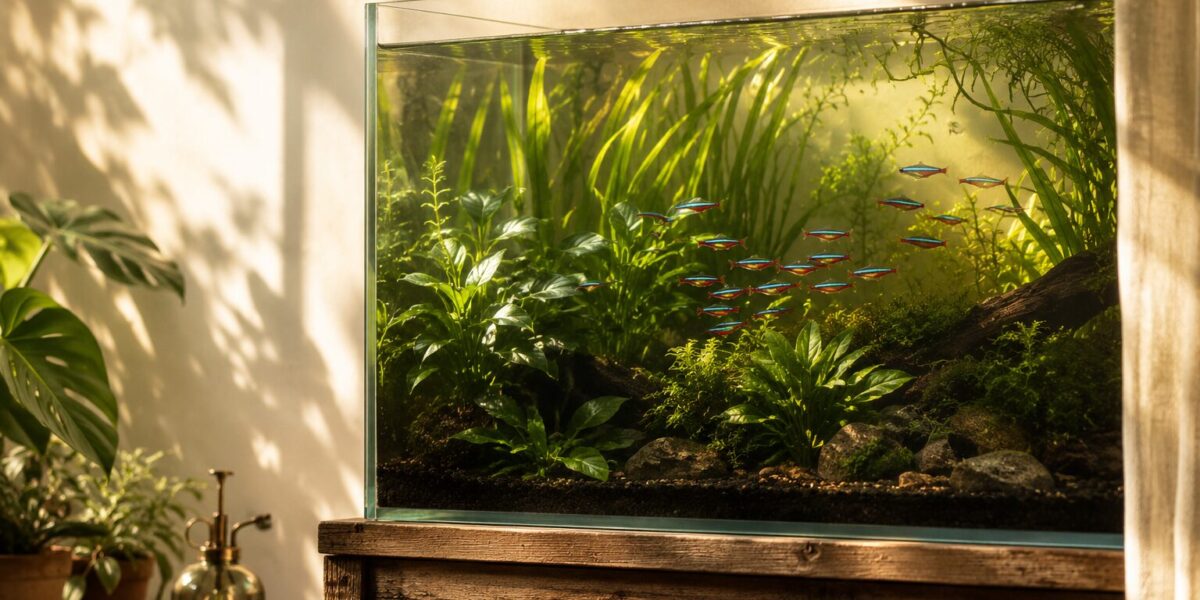
Ask ten aquascapers to name the best fish for planted tank setups and you’ll hear the same theme ten times: the plants come first. A planted aquarium is a small ecosystem, and the wrong fish treats your carefully grown carpet like a salad bar or a construction site. The right fish, though, makes the whole tank come alive — a shoal of glowing tetras drifting through green is the reason most of us got into this hobby in the first place.
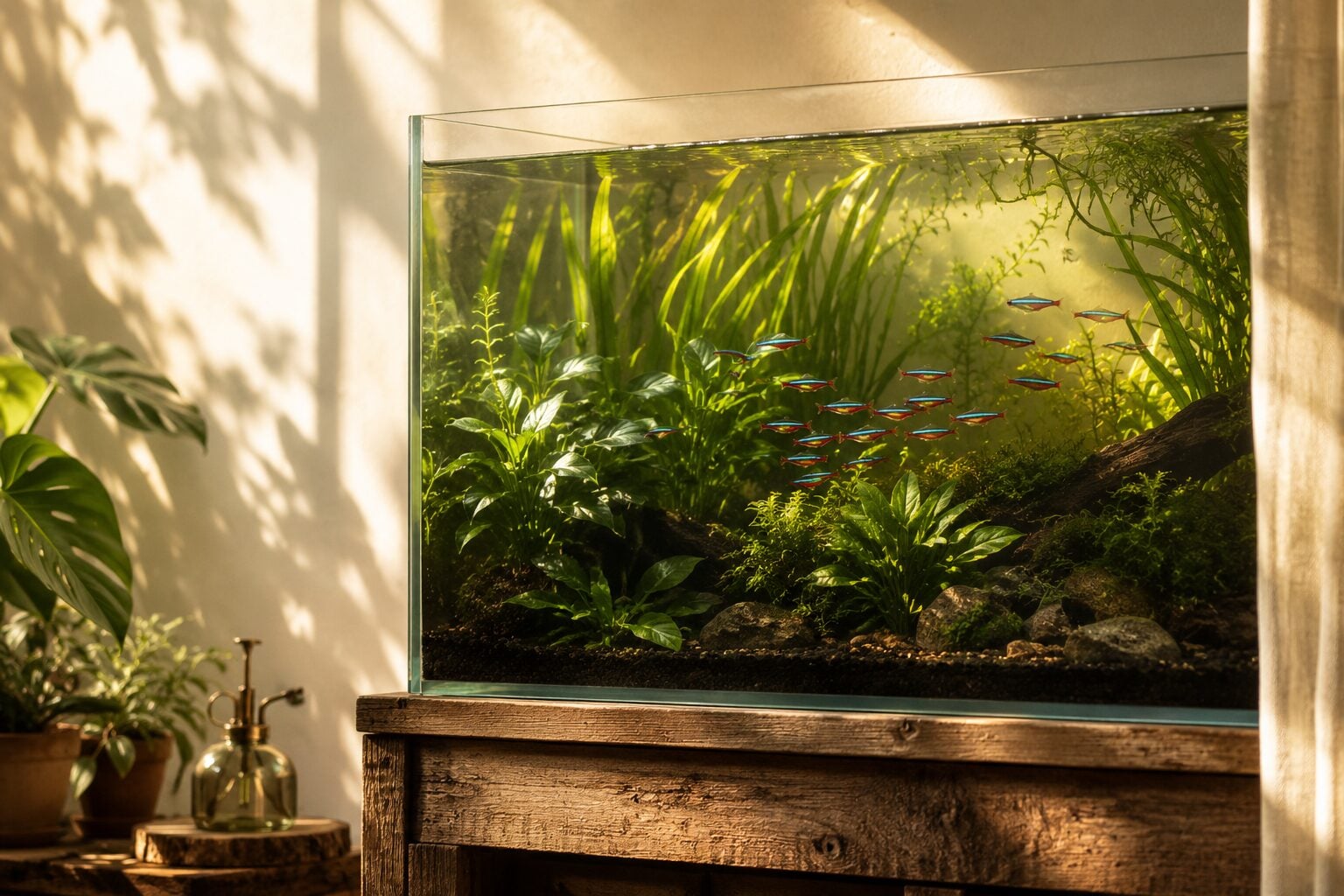
I’ve kept planted tanks for years, and every fish on this list has earned its place the honest way: by living in my aquariums (or those of growers I trust) without shredding a single leaf. Below you’ll find twelve peaceful, beginner-friendly species, the care numbers for each, a quick-reference chart, the cleanup crew worth adding, and — just as important — the popular fish you should politely leave at the store.
What Makes a Fish “Plant-Safe”?
In the wild, plants and fish are partners. Researchers at the University of Florida note that fish use aquatic plants for spawning sites, nursery cover, and refuge from predators — but also that some species eat the plants themselves, along with the algae and tiny animals living on stems and leaves. Your job is simply to stock the partners and skip the grazers.
A good planted-tank fish checks four boxes. It doesn’t uproot: no burly diggers that bulldoze your freshly planted stems. It doesn’t graze: insect- and crustacean-eaters, not leaf-eaters. It runs a modest bioload: small bodies produce less waste, which keeps algae from overwhelming new growth. And it behaves peacefully: calm mid-water schoolers show off the aquascape instead of hiding from a bully.
If you’re still choosing greenery, start with our guide to the best freshwater plants for beginners — hardy species like anubias and java fern shrug off almost any fish on this list.
The 12 Best Fish for Planted Tanks
Every species below is commercially bred in huge numbers — most of them on Florida farms, which produce roughly 95% of ornamental fish raised in the US according to the University of Florida’s ornamental aquaculture program. Captive-bred fish adapt faster, carry fewer parasites, and take prepared foods without drama.
1. Neon Tetra
The classic, and still the first fish I recommend for a planted aquarium. Neons (Paracheirodon innesi) top out around 1.5 inches, eat tiny insects and crustaceans in the wild, and have zero interest in your leaves. Keep at least eight in a 10-gallon or larger tank at 72–78°F. Against a dark substrate and dense green background, that electric blue stripe is unbeatable. Feed a quality micro pellet food sized for small mouths — flakes crushed fine work too.
2. Cardinal Tetra
The neon’s showier cousin, with red running the full length of the body. Cardinals grow slightly larger (about 2 inches) and prefer warmer, softer water — 75–82°F suits them. They’re a touch more sensitive during acclimation, so add them to a tank that’s been running at least a couple of months. A school of twelve cardinals in a mature planted tank is a genuine centerpiece.
3. Ember Tetra
At three-quarters of an inch, embers are perfect for nano planted tanks of 5–10 gallons. They glow like little coals — the orange pops hardest against fine-leaved plants such as rotala. Keep ten or more; in small groups they hide, in proper schools they own the tank.
4. Harlequin Rasbora
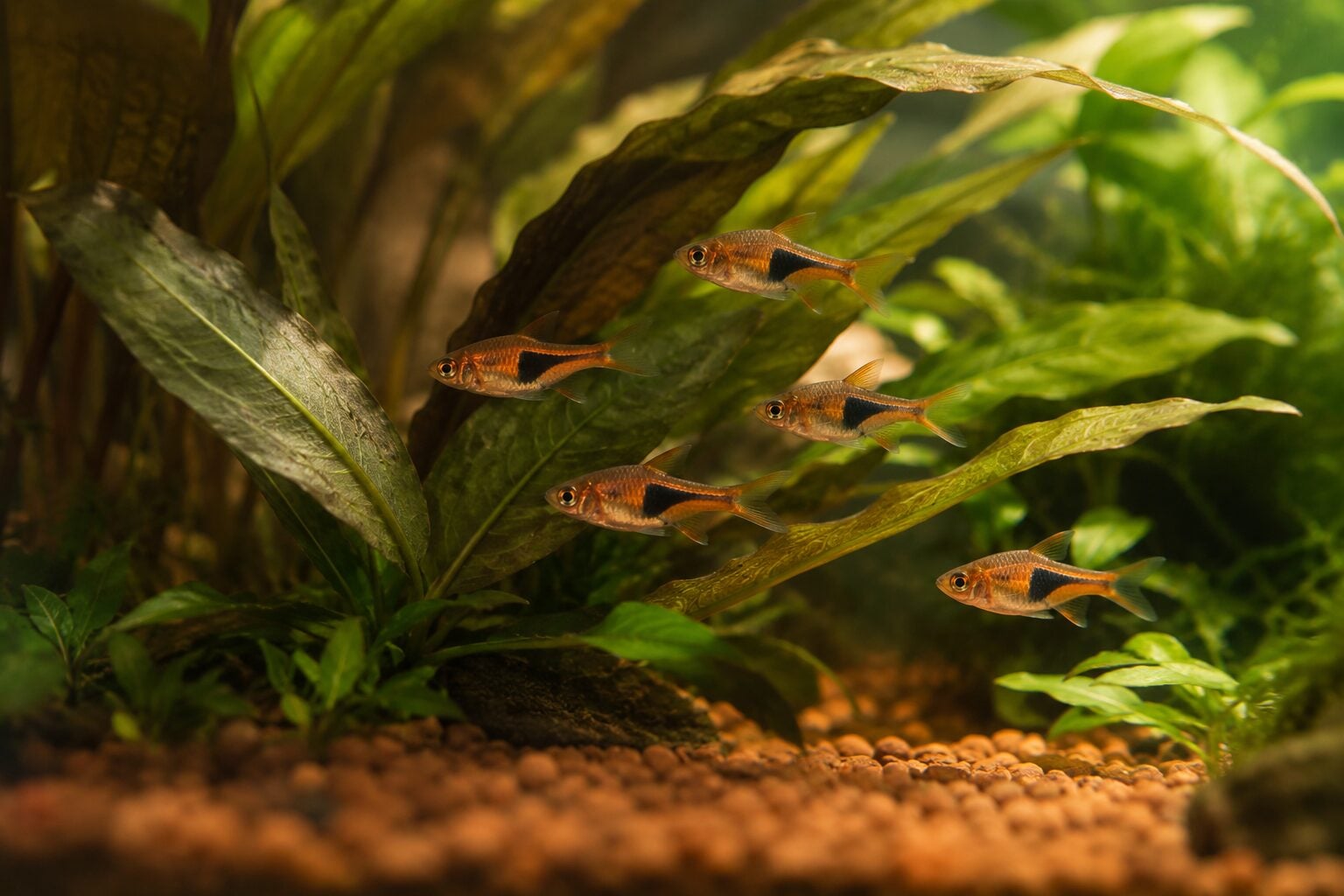
Harlequins (Trigonostigma heteromorpha) are farm-raised staples — mellow, hardy, and about 1.75 inches of copper and black. They’re also one of the few fish that actually use plants to breed, laying eggs on the underside of broad leaves like cryptocoryne. A school of eight in a 10-gallon or larger tank at 72–80°F is as low-maintenance as fishkeeping gets.
5. Chili Rasbora
Smaller still: chili rasboras barely reach 0.7 inches, making them the ultimate nano schooler. They’re peaceful to the point of shyness, so give them dense planting and calm tankmates — shrimp are ideal company. Ten chilis in a heavily planted 5-gallon is a legitimate, complete aquarium.
6. Corydoras Catfish
Cories are the gentlest bottom-dwellers in the hobby. University of Florida aquaculture notes describe them as small armored catfish that sift worms, insect larvae, and detritus from the bottom — and famously dash to the surface to gulp air, which is normal, not distress. They snuffle around roots without ever disturbing them. Keep six or more over smooth sand (sharp gravel wears down their barbels) in 10+ gallons at 72–78°F. Bronze and panda cories are the easiest to find.
7. Otocinclus
The oto is a two-inch algae specialist that grazes the film off leaves without damaging them — think of it as a leaf-polisher. They do best added to mature tanks with visible algae and biofilm, in groups of six, at 72–78°F. If your tank is spotless and new, wait a few months; otos can starve in sterile setups.
8. Guppy
The guppy is the original beginner fish, endlessly farmed in hundreds of color strains. Males stay under 1.5 inches, graze a little soft algae, and ignore plants entirely. One caution: guppies are livebearers, and a trio becomes a crowd within months. Keep males only if you don’t want fry — or embrace the population and let dense plants shelter the babies. 5+ gallons, 72–82°F.
9. Platy
Platies (Xiphophorus maculatus) bring solid blocks of color — sunburst orange, wagtail red — and bulletproof hardiness. Like guppies they’re livebearing algae-nibblers that leave real plants alone. A 10-gallon planted tank handles a small group; again, single-sex keeps numbers stable. 70–80°F.
10. Cherry Barb
Forget the fin-nipping reputation of tiger barbs — cherry barbs are the polite branch of the family. Males blush deep red over ~2 inches, females stay gold. A school of six or more in a planted 15-gallon at 73–81°F shows constant, gentle activity with zero plant damage.
11. Honey Gourami
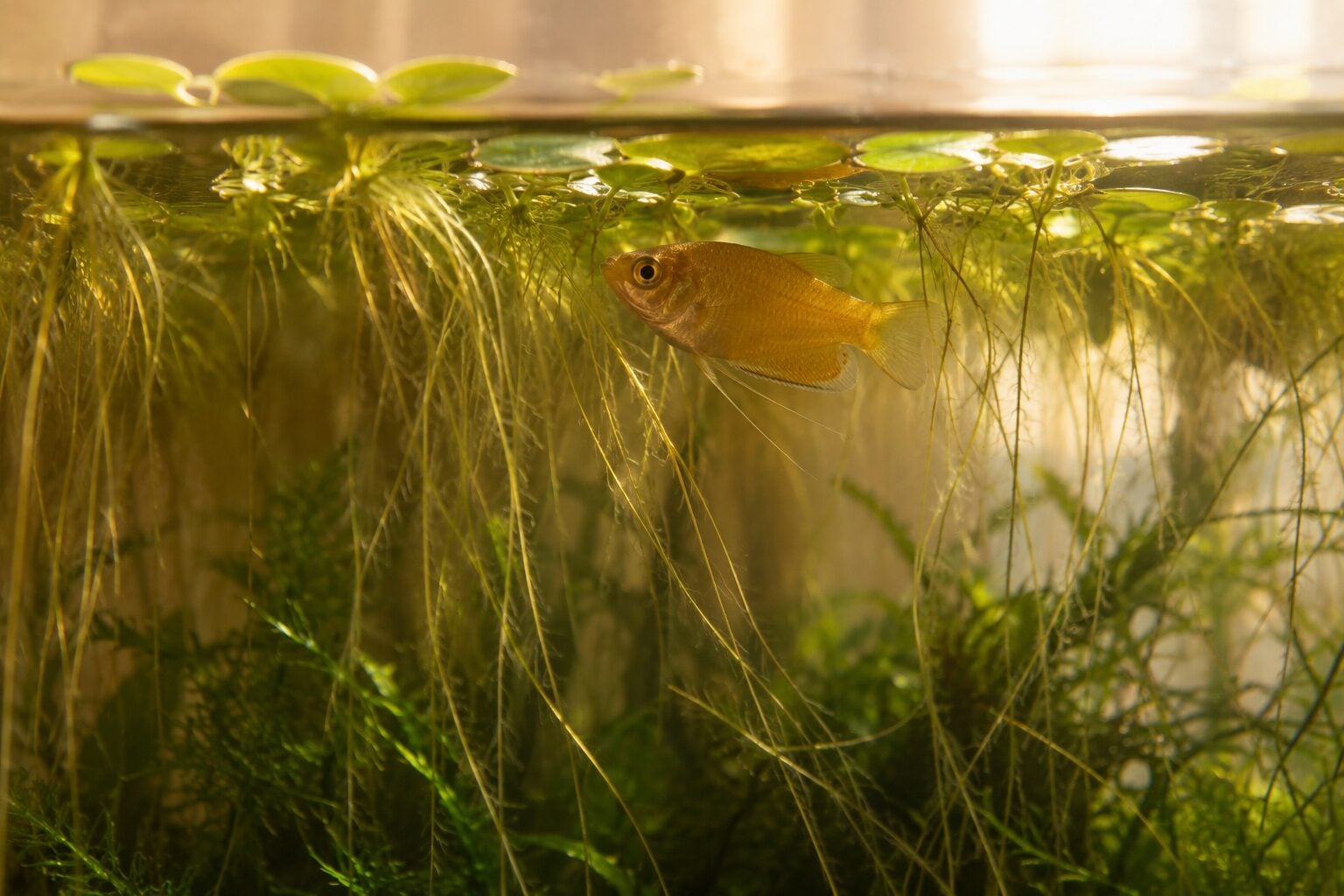
Gouramis are labyrinth fish — they breathe surface air through a lung-like organ, a trait Florida farms have bred around for decades. The honey gourami is the calmest of the group: a 2-inch amber centerpiece that cruises the upper level where few other fish spend time. They adore floating plants, which mimic the bubble-nest cover wild males build. One or a pair in 10+ gallons at 74–82°F.
12. Angelfish (with caveats)
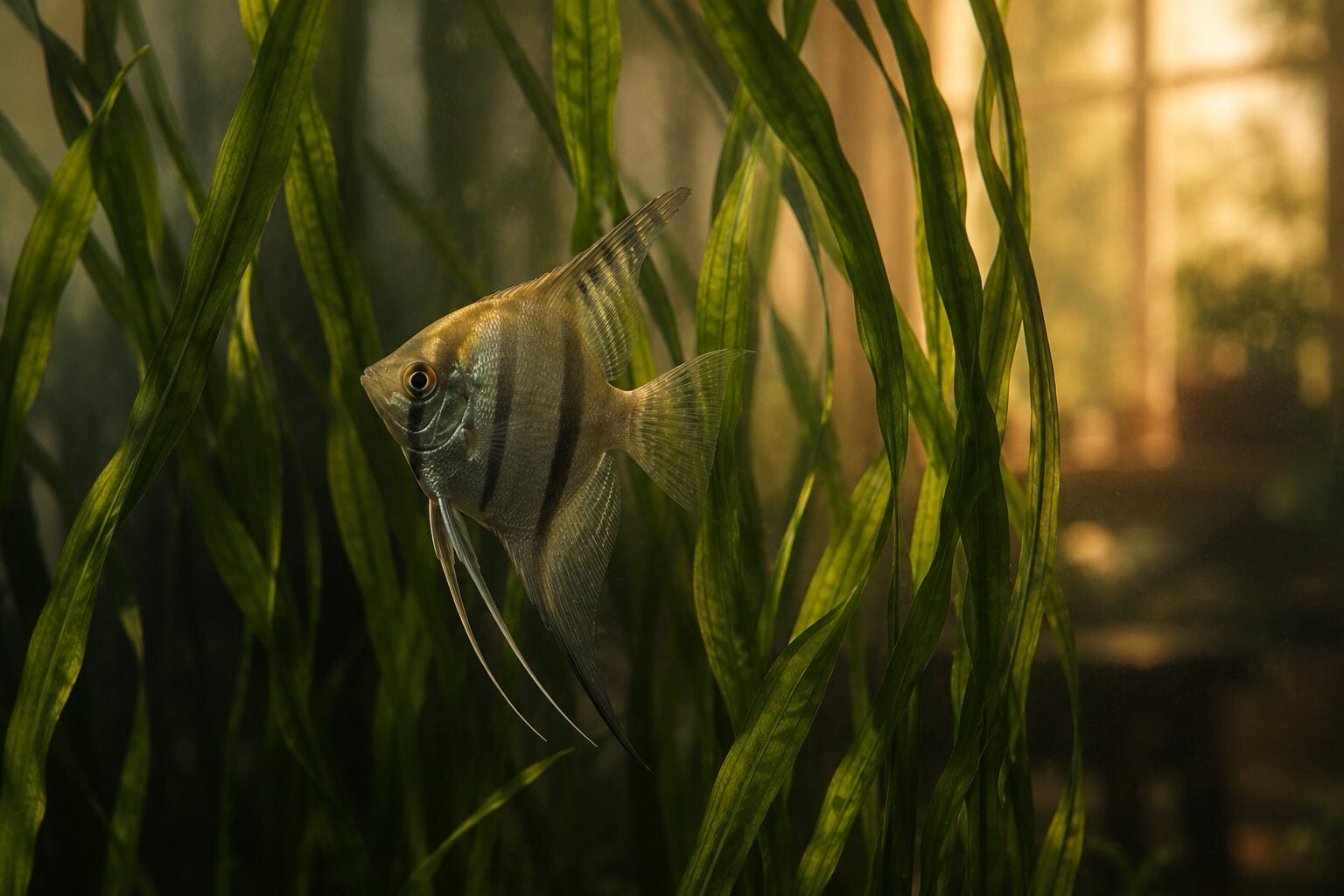
The angelfish (Pterophyllum scalare) is the one big fish on this list. Ohio State’s pet-care extension notes angels reach about six inches and do well in tall, densely planted tanks at 74–84°F. They glide between vertical leaves like they were designed for the job — because they were; their body shape evolved among flooded roots and stems. The caveats: adults will eat shrimp and the tiniest nano fish, and pairs get territorial when breeding. Give them a 29-gallon-or-taller tank and mid-size tankmates like the rasboras and cories above.
Quick Care Chart
| Species | Adult size | Min tank | Temp | Keep as |
|---|---|---|---|---|
| Neon tetra | 1.5″ | 10 gal | 72–78°F | School of 8+ |
| Cardinal tetra | 2″ | 15 gal | 75–82°F | School of 8+ |
| Ember tetra | 0.8″ | 5 gal | 73–82°F | School of 10+ |
| Harlequin rasbora | 1.75″ | 10 gal | 72–80°F | School of 8+ |
| Chili rasbora | 0.7″ | 5 gal | 72–82°F | School of 10+ |
| Corydoras | 1–3″ | 10 gal | 72–78°F | Group of 6+ |
| Otocinclus | 2″ | 10 gal | 72–78°F | Group of 6+ |
| Guppy | 1.5–2″ | 5 gal | 72–82°F | Trio+ |
| Platy | 2–2.5″ | 10 gal | 70–80°F | Trio+ |
| Cherry barb | 2″ | 15 gal | 73–81°F | School of 6+ |
| Honey gourami | 2″ | 10 gal | 74–82°F | Single or pair |
| Angelfish | 6″ | 29 gal tall | 74–84°F | Single or pair |
The Cleanup Crew: Shrimp, Snails, and One Good Pleco
Fish are the show; invertebrates are the maintenance staff. Amano shrimp are tireless algae eaters that never touch healthy leaves, and cherry shrimp add color while grazing biofilm — both are safe with every fish above except adult angels. Nerite snails polish glass and hardscape and can’t reproduce in freshwater, so there’s no snail explosion.
If you want a pleco, choose the bristlenose (Ancistrus). Florida farm data lists bristlenoses at about five inches full-grown — a fraction of the 18 inches a “common” pleco reaches — and they’re dedicated algae-and-wood raspers rather than plant eaters. Give them a piece of driftwood to gnaw; it aids their digestion. Our guide to aquarium plants and rocks covers picking hardscape that suits both the crew and the aquascape.
Fish to Avoid in a Planted Tank
Some beloved fish are simply wrong for the planted aquarium, and it’s kinder to everyone to know before you buy.
- Goldfish and koi. Ohio State’s extension pegs goldfish at 65–72°F — coldwater fish in a tropical setup — and they uproot and eat plants with cheerful persistence. Beautiful animals, wrong tank.
- Common and sailfin plecos. That cute two-incher grows to 18 inches and bulldozes everything rooted.
- Buenos Aires tetra. The one common tetra that genuinely eats leaves. It will mow a planted tank.
- Silver dollars and pacu. Close relatives, both herbivores. Silver dollars treat a planted tank as a buffet.
- Oscars and other large cichlids. University of Florida notes some cichlids exceed 20 inches; big cichlids redecorate constantly, and their idea of feng shui involves uprooting everything.
- Mbuna (African rock cichlids). Many are specialized algae-scrapers and plant-nibblers with rowdy manners to match.
Stocking a Planted Tank the Right Way
The fastest way to lose fish is to add them to a tank that isn’t ready. Cycle the aquarium fully first — if you’re starting from an empty glass box, our step-by-step tropical fishtank setup guide walks through cycling in detail. Plants actually speed this up: they consume ammonia directly, which is one more reason the planted route is the beginner-friendly route.
Test before every stocking trip. A liquid water test kit should read zero ammonia and zero nitrite before any fish goes in. Then stock gradually — one school at a time, a week or two apart — so the beneficial bacteria keep pace.
Buy full schools, not samples. Six is the floor for schooling species; eight to twelve is where the behavior gets good. A stressed trio of tetras hides; a proper school parades. Specialist retailers like Aquarium Co-Op and Buce Plant are also worth a look for healthy livestock-safe plants and gear, alongside your local fish store.
Quarantine newcomers when you can. A simple breeder net box or a spare 5-gallon lets you watch new fish for two weeks before they meet the main display. It’s the cheapest disease insurance in the hobby.
Setting the Stage for Your Fish
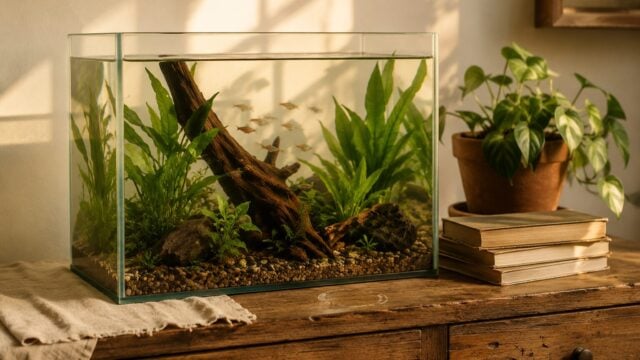
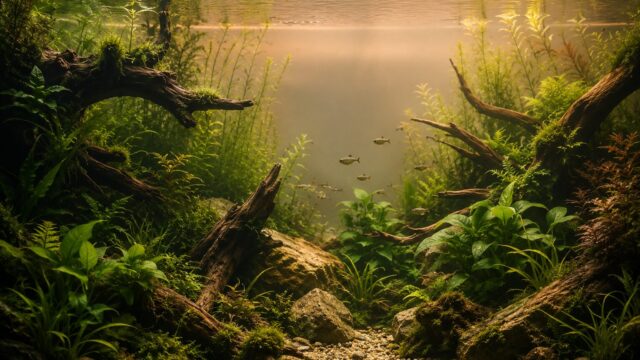
A quick word on the tank itself, because the fish look only as good as the aquascape. A nutrient-rich aquarium plant substrate feeds root plants like the cryptocoryne your rasboras will spawn under, and a full-spectrum LED planted tank light on a 7–8 hour timer keeps growth steady without inviting algae. Browse the full aquatic plants section for species guides as your confidence grows.
Lighting matters for the fish, too. Most species on this list color up best under gentle light with shaded retreats — another argument for tall stems and floating cover rather than a bare bright box.
Feeding a Planted Community
Feeding is where new keepers accidentally sabotage their plants. Uneaten food breaks down into ammonia and phosphate, and both feed algae faster than they feed anything you actually want growing. The rule that has served me for years: feed only what disappears in about two minutes, once or twice a day, and skip a day each week entirely. Every fish on this list evolved to eat small and often — insects, crustaceans, biofilm — and none of them will starve on a lean schedule.
Vary the menu. Micro pellets or crushed flake make a fine staple, but tetras and rasboras color up noticeably on occasional frozen or freeze-dried treats like daphnia and brine shrimp. Bottom-dwellers need food that actually reaches them: sinking wafers dropped after lights-out give cories a fair share before the midwater crowd notices. Otos and bristlenose plecos should always have a leaf of blanched zucchini or an algae wafer available in tanks too clean to graze.
Watch the fish, not the clock. Rounded bellies and active foraging mean you’re feeding enough; a haze of leftovers on the substrate means you’re feeding the algae instead.
Planted Tank Fish FAQ
How many fish can I put in my planted tank?
Live plants raise the ceiling — they consume the nitrogen fish produce — but stock for the tank you had on day one, not the jungle you hope to grow. A sensible starting point for small schoolers is roughly one inch of adult fish per gallon, added over several weeks. A 20-gallon planted tank comfortably houses a school of ten neons, six cories, and a honey gourami with room to spare. When in doubt, understock: sparse fish in lush plants always looks better than the reverse.
Will these fish eat my plants?
No — that’s the point of the list. Every species here is an insect-eater, micro-grazer, or algae specialist. What looks like plant-eating is usually a fish picking biofilm off a leaf, or snacking on a leaf that was already dying. If you see genuine holes in healthy leaves, the culprit is almost always a snail hitchhiker or a nutrient deficiency, not one of these twelve.
Do I need CO2 injection for these fish?
The fish don’t care, and the beginner plants don’t either. Pressurized CO2 accelerates plant growth but adds cost and complexity, and a heavily planted low-tech tank full of anubias, java fern, crypts, and floating plants thrives without it. If you later chase carpeting plants and dense red stems, revisit CO2 — with the caveat that a misadjusted system can suffocate fish overnight, so start with a drop checker and err low.
What’s the single best fish for planted tank beginners?
If I could pick only one species, it would be the harlequin rasbora: hardy enough to forgive early mistakes, peaceful with everything, active in open water, and genuinely beautiful against green. Add cories underneath, and you have a two-species tank that never stops being pleasant to watch.
Can I keep shrimp with all of these fish?
Adult cherry and amano shrimp are safe with everything except angelfish, which regard shrimp as an artisanal snack. Baby shrimp are fair game for nearly any fish, though — in a colony tank, dense moss and plant cover is what keeps the population growing faster than the fish can hunt it.
Final Thoughts
The best fish for planted tanks are small, peaceful, captive-bred species that evolved alongside vegetation rather than in spite of it: tetras and rasboras in the midwater, cories and otos below, a honey gourami above, and — with space and planning — an angelfish gliding through the middle like the tank’s quiet landlord. Stock slowly, school generously, skip the diggers and grazers, and your plants and fish will do what they’ve done together for millions of years: make each other look wonderful.
The planted tank starter kit
- 2 Pieces Fish Tank Breeder Net Mesh Breeder Box Fish Hatchery… — breeder net box
- Aqueon Plant and Shrimp Aquarium Substrate, Aqua Soil for Fish Tanks,… — aquarium plant substrate
- hygger Advanced LED Aquarium Light with Timer, 24/7 Lighting Cycle &… — full-spectrum LED planted tank light
- Hikari Tropical Semi-Floating Micro Pellets Fish Food, 0.77 Oz (22g) — micro pellet food
- AAwipes 8-in-1 Aquarium Test Kit for Fish Tanks – Quick & Accurate… — liquid water test kit
Opens Amazon’s cart confirmation page — you review the list and prices there, and nothing is added until you approve it. Prefer to pick and choose? Every item above links to its own product page.
Leave a Reply