
Humble Acres is reader-supported. When you buy through links on our site, we may earn an affiliate commission at no extra cost to you — we only recommend products we’d use ourselves. See our affiliate disclosure.
The planted tank starter kit
- 4Pcs Aquascaping Tools, Jeimier Aquascape Kit, Long and Strong… — long aquascaping tweezers
- API ROOT TABS Freshwater Aquarium Plant Fertilizer 0.4-Ounce 10-Count… — root tabs
- Hygger CO2 HC035 All-in-One Liquid Aquarium Plant Fertilizer – with… — an all-in-one liquid fertilizer
- SEAOURA Led Aquarium Light for Plants-Full Spectrum Fish Tank Light… — full-spectrum LED aquarium plant light
- Aqueon Plant and Shrimp Aquarium Substrate, Aqua Soil for Fish Tanks,… — aquasoil-style nutrient substrate
Opens Amazon’s cart confirmation page — you review the list and prices there, and nothing is added until you approve it. Prefer to pick and choose? Every item above links to its own product page.
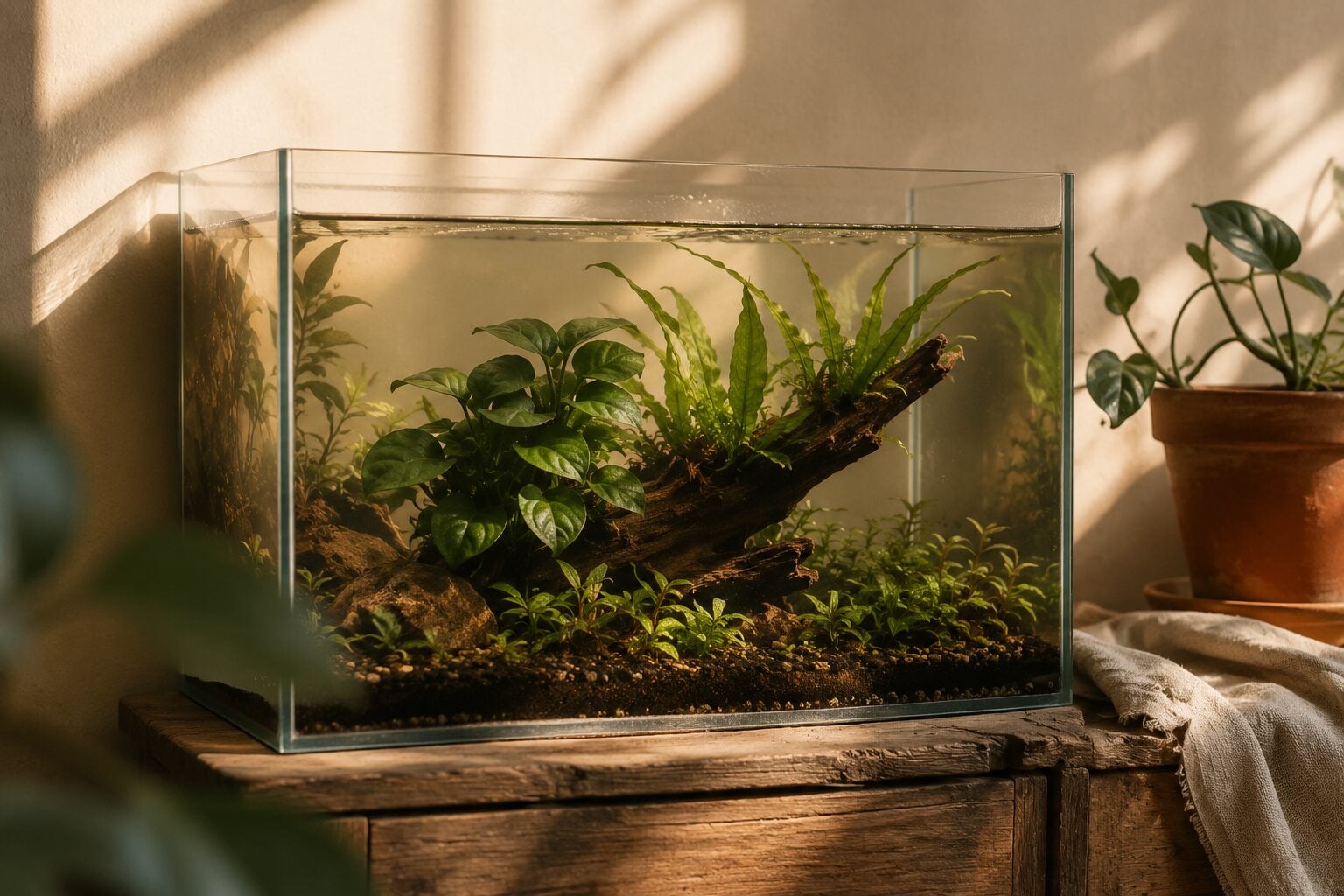
Freshwater plants are the single upgrade that turns a fish tank from a box of water into something alive. I have kept plastic decorations and I have kept live plants, and there is no contest: the planted tank is quieter, cleaner, less algae-prone, and infinitely better to sit in front of at the end of a long day. If you have been circling the idea of live freshwater plants but you are worried you will kill them, this guide is the one I wish someone had handed me before my first sad, melting bunch of Amazon sword.
Why freshwater plants beat plastic every single time
The case for live freshwater plants is not decorative. It is chemical. Fish produce ammonia continuously through their gills and waste, and uneaten food decays into more of it. Ammonia is the thing that kills beginner tanks. The University of Florida IFAS Extension is blunt about the numbers: un-ionized ammonia is extremely toxic to fish, doing measurable damage above roughly 0.05 mg/L and killing outright around 2.0 mg/L. Worse for tropical keepers, the toxic un-ionized fraction climbs as temperature and pH climb — exactly the conditions a tropical community tank runs at.
Plants are a second line of defense. They pull nitrogen out of the water column and out of the substrate and turn it into leaves. In a well-planted tank, nitrate creeps up slowly instead of galloping, water changes get easier, and algae — which is really just a plant that beat your plants to the buffet — has less to eat. That is the whole pitch, and it is a good one.
There is also the part nobody puts in the fact sheets. A tank full of freshwater plants moves. Leaves sway on the filter return, pearls of oxygen bead up on java fern in the afternoon, shrimp graze the moss. Plastic just sits there fading.
The nitrogen cycle, and where freshwater plants fit into it
Before a single plant matters, the tank has to cycle. Beneficial bacteria colonize your filter media and substrate and do the work in two steps: Nitrosomonas-type bacteria convert ammonia into nitrite, and Nitrobacter-type bacteria convert nitrite into far less harmful nitrate. That process takes roughly four to six weeks in a new tank, and it runs faster warm than cold — bacteria colonize noticeably quicker at tropical temperatures around 75–80°F (24–27°C) than at room temperature.
Here is the part beginners miss: freshwater plants do not replace the cycle, they supplement it. Plants take up ammonium and nitrate directly as fertilizer, which is why a heavily planted tank often shows lower nitrate readings than the stocking level would suggest. But plants are slow and bacteria are fast. Never skip cycling because you added plants.
What plants do do is buffer the wobbles. A tank with a healthy mass of freshwater plants absorbs a small overfeeding or a missed water change without a spike. That margin for error is the real gift for a first-time keeper.
Test, do not guess
Ammonia test kits read total ammonia nitrogen, not the toxic un-ionized fraction — you need pH and temperature to know how bad a reading really is. Practically: keep ammonia and nitrite at zero, keep nitrate under about 40 ppm with water changes, and let the plants do the rest.
The 12 best freshwater plants for beginners
Every plant below is what the hobby calls “low tech”: no pressurized CO2, no expensive lighting rig, no daily dosing schedule. They ask for a timer, a modest light, and to be planted correctly. That is it.
1. Anubias (Anubias barteri, A. nana)
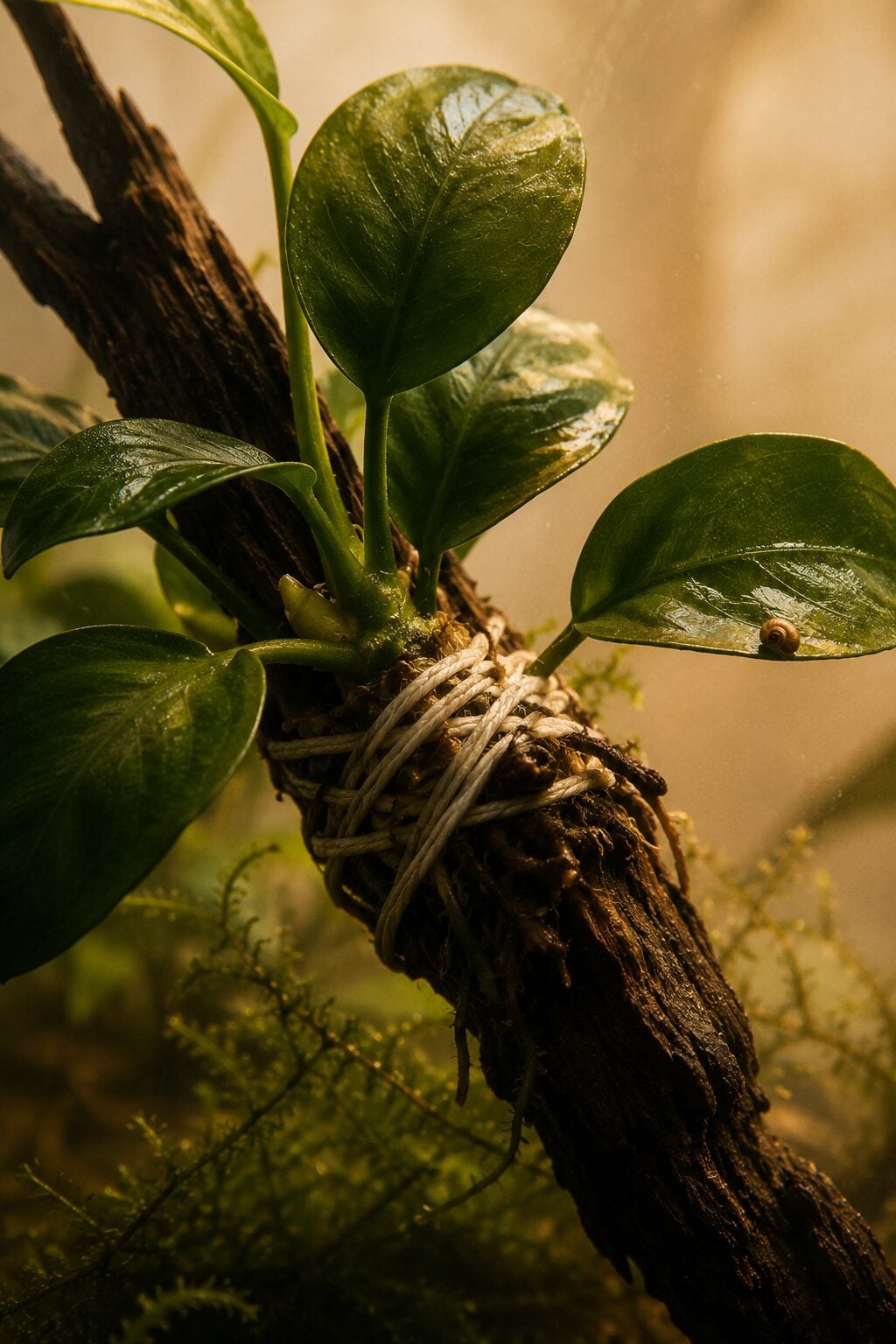
The plant I recommend to everyone. Low to moderate light, thick leathery leaves that fish will not shred, and growth so slow you will measure it in months. The one rule that matters: the rhizome — the thick horizontal stem the leaves grow from — must never be buried. Tie or glue it to driftwood or rock. Bury it and it rots, every time. Mature size runs 6–16 inches depending on variety; growth rate is very slow.
2. Java fern (Microsorum pteropus)
Same rule, same reward. Java fern is a rhizome plant that attaches to hardscape and tolerates low light, hard water, and neglect. Its leaves develop little brown-black bumps on the undersides — those are baby plants, not disease. Pluck them off and glue them to a new rock. Free plants forever.
3. Cryptocoryne wendtii
Crypts are the workhorse midground plant: low light, root feeders, endlessly forgiving once established. They are also the reason half of new planted-tank owners panic. Cryptocoryne melt — every leaf dissolving within days of planting — is a normal stress response to a change in water parameters. Do not pull the plant. Trim the mush, leave the roots, and it grows back adapted within a few weeks.
4. Amazon sword (Echinodorus)
The classic background statement plant, and a heavy root feeder. It wants a nutrient substrate or gravel supplemented with root tabs every two to three months. Give it room; a happy sword will fill a third of a 20-gallon tank.
5. Java moss
Attaches to anything, grows in anything, and shrimp adore it. Tie a thin layer to a mesh pad or a stone and let it fill in. The best hiding place for fry you will ever buy.
6. Hornwort
The nutrient sponge. Hornwort grows fast enough to visibly outcompete algae, float it or root it, and hack it back weekly. If a new tank is fighting algae, hornwort is the fastest fix among freshwater plants.
7. Anacharis / Elodea
Another fast stem plant that will grow in a bucket on a windowsill. It carries a caveat that deserves its own section below: it is genuinely invasive outside the aquarium, and some retailers have stopped selling it for that reason.
8. Vallisneria
Tall ribbon grass for the back wall, spreading by runners into a jungle. Low tech, low light, and hypnotic in a filter current.
9. Cryptocoryne parva, 10. Bucephalandra, 11. Dwarf sagittaria, 12. Water sprite
Rounding out the list: crypt parva for a slow foreground, bucephalandra as the fancy-but-easy rhizome plant, dwarf sagittaria for a low-light carpet that does not need CO2, and water sprite as a floating or planted fast grower. All of them belong in the same low-tech bucket as everything above.
Light, substrate, CO2 and fertilizer: the four levers
Almost every freshwater plant failure traces back to one of four settings, and none of them are expensive to get right.
Light
Low-light freshwater plants want roughly 15–30 PAR at the substrate and a photoperiod of seven to nine hours. That is it. More light is not better — more light without matching CO2 and nutrients is simply an invitation to algae. Put the light on a plug timer the day you buy it. A basic full-spectrum LED aquarium plant light with a built-in timer covers everything on this list.
Substrate
Two categories of plant, two strategies. Rhizome plants (anubias, java fern, bucephalandra) and mosses do not touch the substrate at all — they attach to hardscape, and burying them kills them. Root feeders (crypts, swords, vals, sagittaria) want either an aquasoil-style nutrient substrate or plain gravel dosed with root tabs every two to three months. Plant them stem-deep, keeping the crown — where leaves meet roots — above the gravel line.
CO2
You do not need it. Every plant in this guide grows in a low-tech, no-injection tank. Pressurized CO2 is what you graduate to when you want a red carpeting foreground and a demanding aquascape, not what you start with.
Fertilizer
One comprehensive liquid fertilizer, dosed once a week at roughly half the label dose, covers macro and micronutrients for a low-tech planted tank. Combine that with root tabs near your heavy feeders and you are done thinking about nutrients.
Planting day: how to actually put freshwater plants in a tank
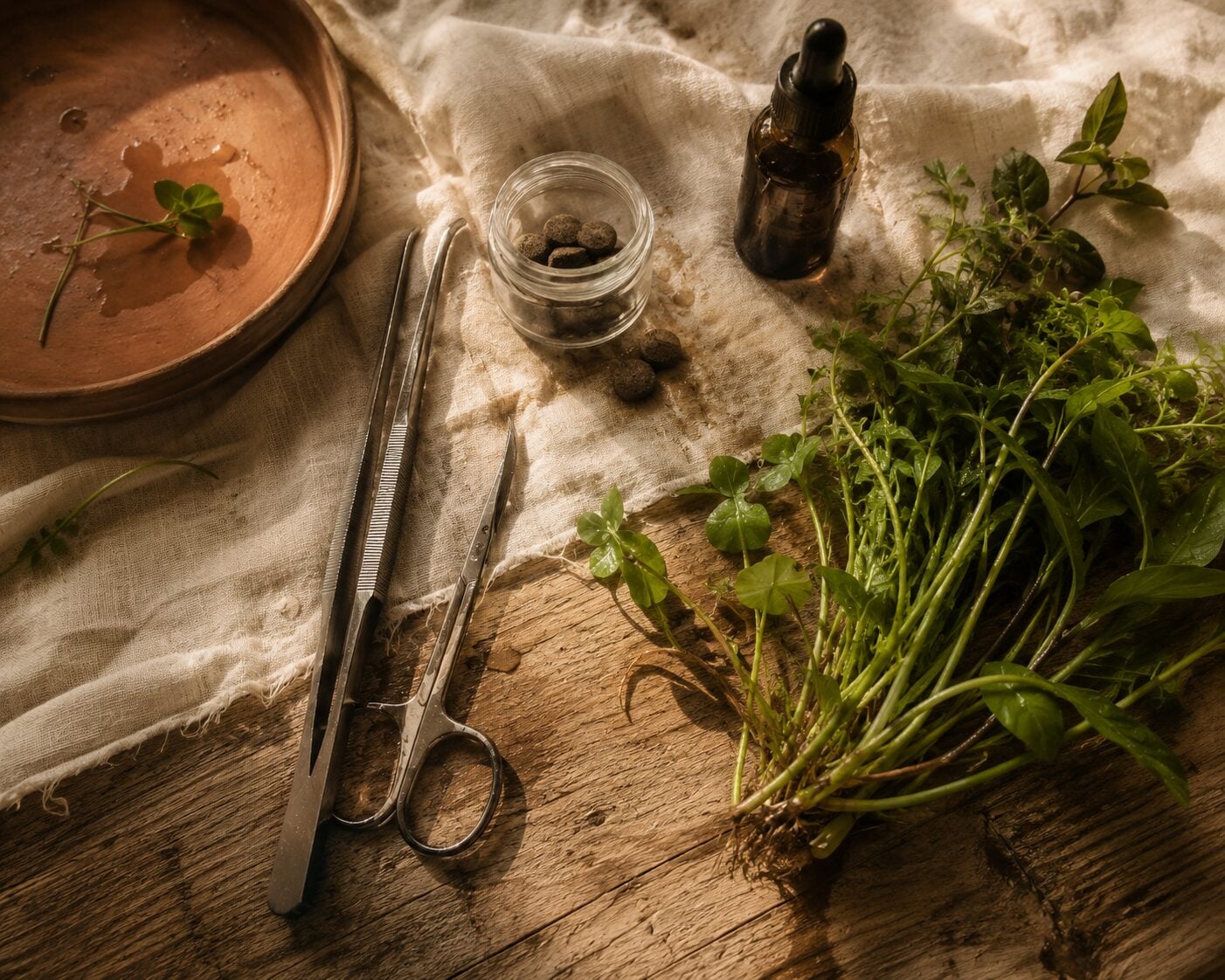
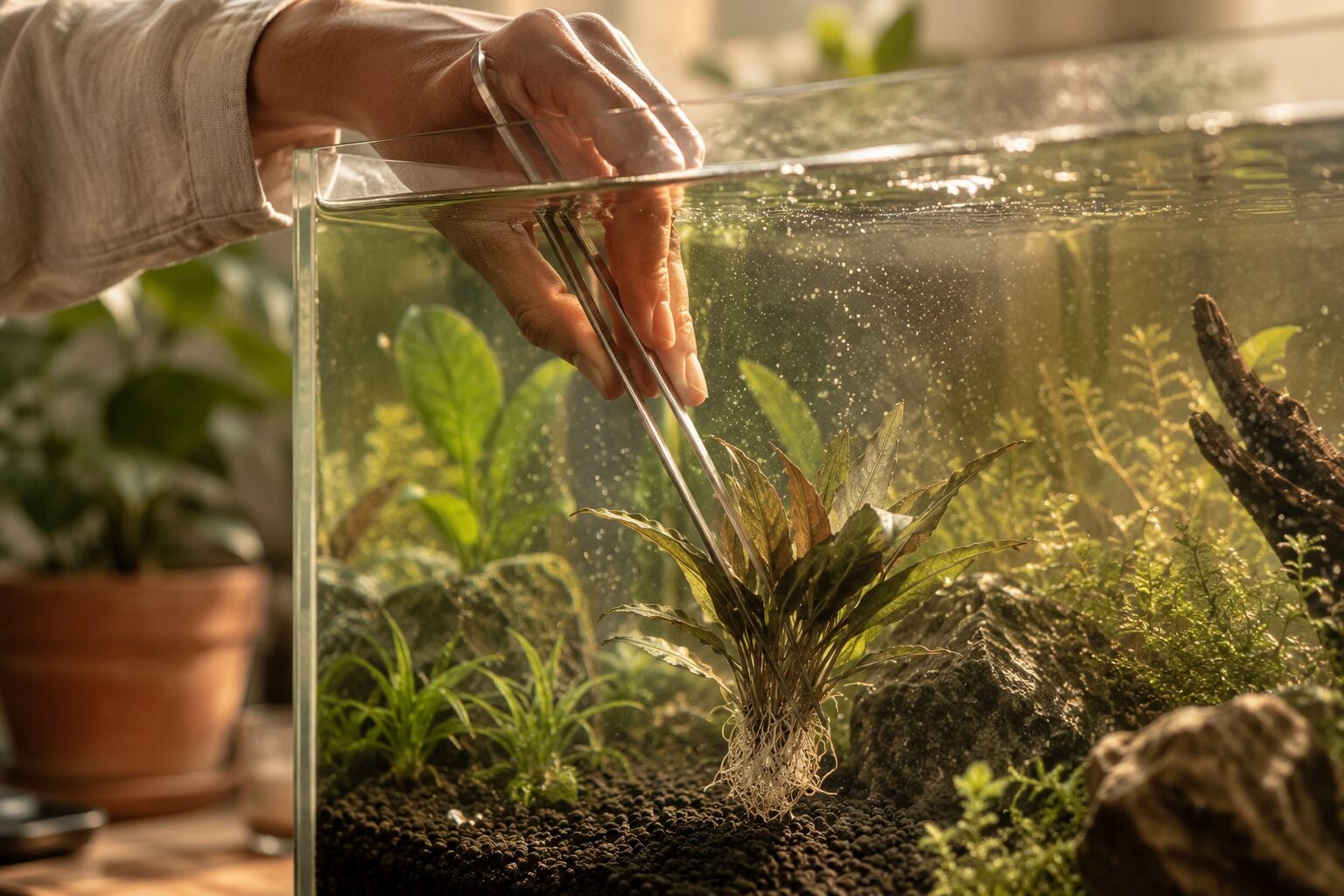
Buy a pair of long aquascaping tweezers before you buy plants. Trying to bury a delicate crypt root with your fingers in ten inches of water is a genuinely miserable experience, and the tweezers cost less than the plants you will otherwise uproot.
The sequence: rinse each plant under cool tap water and inspect it. Pull off any pest snails or their jelly-like egg clutches, and cut away brown or mushy leaves and any rockwool or lead weight from the nursery pot — rockwool left around the roots suffocates them. Then plant. Root feeders go into the substrate stem-deep with the crown proud of the gravel; rhizome plants get tied or superglued (cyanoacrylate gel is aquarium safe) to hardscape; mosses get pressed flat against a stone and lashed down with cotton thread.
Expect a rough fortnight. Nursery plants are usually grown emersed — out of water — and their existing leaves are not built for submerged life. Those leaves may yellow and drop while the plant pushes out new, submerged-form growth. This is not failure. It is the plant retooling.
The rule you cannot skip: never release aquarium plants
This is the part of the hobby that carries real-world consequences, and it deserves more than a footnote. Hydrilla, one of the most destructive aquatic weeds in the United States, was introduced in the early 1950s through the aquarium trade. It now chokes waterways across the South, and public agencies spend millions a year fighting it.
UF/IFAS’s Center for Aquatic and Invasive Plants calls plants like this aquatic hitchhikers, and the guidance is simple. Never dump aquarium plants, trimmings, or tank water into a pond, ditch, storm drain, or waterway. When you trim your freshwater plants, the cuttings go in the trash, in a sealed bag, or into a compost pile well away from water. Give spares to another hobbyist instead of releasing them. It takes ten extra seconds and it is the difference between a hobby and a hazard.
Troubleshooting the four problems everyone hits
My crypts melted overnight
Normal. Crypt melt is a documented response to changing water parameters, and it happens most often right after planting. Remove the dissolved leaves so they do not foul the water, leave the root mass entirely alone, and wait. New leaves — adapted to your water — appear within two to four weeks.
My leaves are yellow, or full of holes
Usually a nutrient deficiency rather than a disease. Yellowing between the veins points to iron or micronutrients; holes and translucent patches in sword and crypt leaves usually mean the root feeders are hungry. Root tabs and a weekly half-dose of liquid fertilizer fix nearly all of it.
My anubias or java fern is rotting
Nine times out of ten it is buried. Dig it up, check that the rhizome sits fully above the substrate, and reattach it to wood or stone. The other one time out of ten it is buried under a blanket of algae because the light is on too long.
Algae is eating everything
Algae is a symptom, not a species problem. The usual culprits are too many hours of light, too much light intensity, and excess nutrients from overfeeding. Cut the photoperiod to seven hours, feed the fish less, add a fast grower like hornwort to soak up the surplus, and be patient. Chemical treatments treat the symptom and leave the cause.
Stocking your first planted tank: a realistic shopping list
If I were starting again tomorrow with a 20-gallon tank, this is the exact list. One nutrient substrate or plain gravel plus root tabs. One LED light on a timer. A piece of driftwood and two stones. Three anubias, two java fern, six crypt wendtii, one Amazon sword, a handful of hornwort, and a golf-ball of java moss. One bottle of all-in-one liquid fertilizer. Tweezers and curved scissors.
Where to buy matters more than people admit. Big-box freshwater plants are often emersed-grown, sitting under dry lights, sold with pest snails included. Specialist aquatic nurseries — the Buce Plant and Aquarium Co-Op crowd — ship submerged-grown, quarantined stock that transitions with almost no melt, and it costs barely more. For gear, though, Amazon is genuinely the cheapest sane option: an all-in-one liquid fertilizer and a decent light do not need a boutique.
Then plant heavily on day one. The most common beginner mistake is a sparse tank — six lonely stems in a big empty box, which is a tank that algae wins. Plant twice as much as looks reasonable. The freshwater plants will fill in, and you will thank yourself in a month.
Bringing the same instincts to the rest of your plants
Nearly everything that makes an aquarium work makes a windowsill work too: right light for the plant rather than maximum light, water on the plant’s schedule rather than yours, and nutrients where the roots actually are. If you have got the planted-tank bug, the same patience translates beautifully to a general plant care routine, to easy houseplants that forgive a missed watering the way anubias forgives a missed dose, and to a closed terrarium, which is honestly just an aquarium with the water taken out and the humidity left in.
Water parameters your freshwater plants actually care about
Plants are far less fussy about water chemistry than fish forums suggest, but a few numbers are worth knowing. Temperature in the tropical community range — 75–80°F (24–27°C) — suits every species on this list, and it happens to be the range where beneficial bacteria colonize fastest. pH between about 6.5 and 7.5 is comfortable for anubias, java fern, crypts, swords and moss alike; none of them need you to chase a decimal point with chemicals.
Hardness matters more than pH in practice. Very soft, near-zero-hardness water leaves plants short of calcium and magnesium, which shows up as stunted new growth and brittle leaf edges. If your tap water is extremely soft, a remineralizer or a small dose of a GH-boosting supplement solves it. Most municipal tap water is already fine.
What plants genuinely cannot tolerate is instability — a swing in temperature, hardness or pH is what triggers crypt melt and stalls growth across the board. Change water in modest weekly amounts rather than large occasional ones, match the temperature roughly when you refill, and treat for chlorine and chloramine every time. Chlorine damages plant tissue as readily as it damages fish gills and the bacterial colony you spent six weeks building.
Fish that get along with a planted tank
Not every fish is a good neighbor. Goldfish and most large cichlids treat freshwater plants as salad and landscaping projects, uprooting and shredding as they go. Silver dollars and some barbs are worse. The reliably plant-safe crowd is the classic community list: tetras, rasboras, corydoras, otocinclus, guppies, and dwarf shrimp — and shrimp in particular will earn their keep by grazing algae off leaves you cannot reach.
The short version
Cycle the tank first — plants supplement bacteria, they do not replace them. Choose low-tech freshwater plants: anubias, java fern, crypts, moss, hornwort, vals, swords. Never bury a rhizome and never leave a crown under the gravel. Run the light seven to nine hours on a timer, feed the root feeders with root tabs, dose a half-strength all-in-one weekly, and skip the CO2 entirely. Expect melt, wait it out, and never, ever release a trimming into wild water.
Do that and freshwater plants are not the hard part of fishkeeping. They are the part that makes the rest of it easy.
The planted tank starter kit
- 4Pcs Aquascaping Tools, Jeimier Aquascape Kit, Long and Strong… — long aquascaping tweezers
- API ROOT TABS Freshwater Aquarium Plant Fertilizer 0.4-Ounce 10-Count… — root tabs
- Hygger CO2 HC035 All-in-One Liquid Aquarium Plant Fertilizer – with… — an all-in-one liquid fertilizer
- SEAOURA Led Aquarium Light for Plants-Full Spectrum Fish Tank Light… — full-spectrum LED aquarium plant light
- Aqueon Plant and Shrimp Aquarium Substrate, Aqua Soil for Fish Tanks,… — aquasoil-style nutrient substrate
Opens Amazon’s cart confirmation page — you review the list and prices there, and nothing is added until you approve it. Prefer to pick and choose? Every item above links to its own product page.
Leave a Reply