
Humble Acres is reader-supported. When you buy through links on our site, we may earn an affiliate commission at no extra cost to you — we only recommend products we’d use ourselves. See our affiliate disclosure.
The planted tank starter kit
- API ROOT TABS Freshwater Aquarium Plant Fertilizer 0.4-Ounce 10-Count… — aquarium root tabs
- hygger Clip On Full Spectrum Aquarium LED Light, 22W Day-Night Dual… — adjustable full-spectrum planted-tank LED
- Doter Aquatic Soil for Plants – 2.2LBS, Clay Aquarium Soil Suitable… — aquatic plant pot and pond soil kit
- Mosquito Dunks 6's – Biological Mosquito Control — bti mosquito dunks
Opens Amazon’s cart confirmation page — you review the list and prices there, and nothing is added until you approve it. Prefer to pick and choose? Every item above links to its own product page.
Aquatic plants are the only plants in the hobby that ask you to garden in a medium you cannot walk on. That single fact changes everything: how they feed, how they breathe, how deep they sit, and how badly things go when you get the depth wrong. Once you understand that aquatic plants are sorted by where they live in the water column rather than by family or leaf shape, the whole category stops being intimidating and starts being obvious.
What actually counts as an aquatic plant
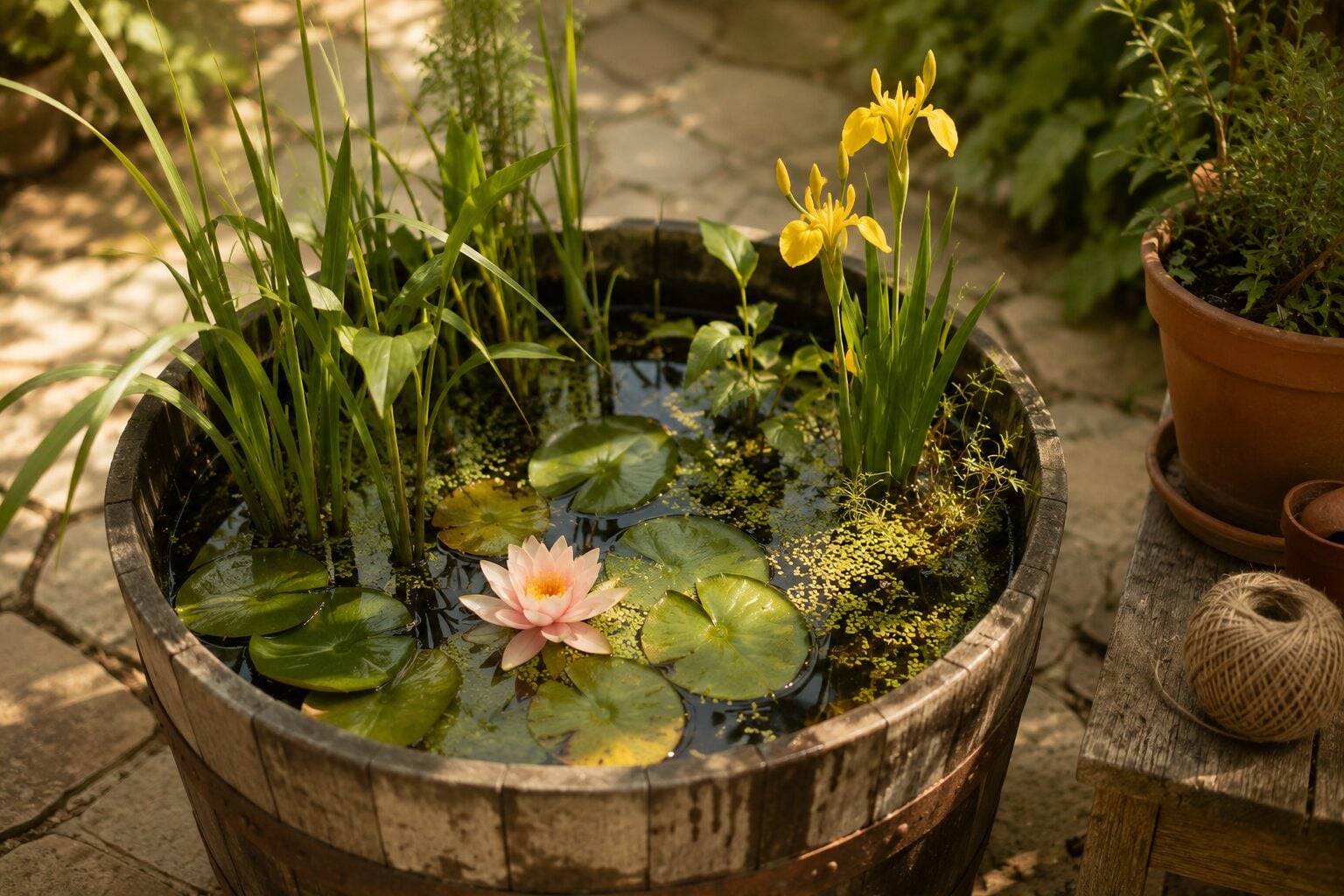
An aquatic plant is any plant adapted to live with its roots — and often most of its body — permanently in water or saturated soil. Penn State Extension groups them not by botanical family but by growth habit, because habit is what determines care. Their four categories are submerged, emergent, floating-leaf, and free-floating.
That grouping is practical, not academic. It tells you how deep to sink the pot, how much light will actually reach the leaves, and which species will quietly take over. Two plants from completely different families can have identical care requirements if they share a growth habit, which is why experienced growers think in habits first and species second.
Aquatic plants also do real work. UF/IFAS notes that they form the base of the aquatic food web, release oxygen into the water, anchor sediment so it does not cloud the water, and give fish and invertebrates cover to hide and spawn in. A tank or tub with healthy plants is more stable than one without — not because plants are decorative, but because they are metabolically busy.
Why aquatic plants behave differently from houseplants
Water holds far less dissolved carbon dioxide and oxygen than air does, and it moves nutrients slowly. Submerged leaves have thin cuticles and often no functional stomata, so they absorb what they need directly through the leaf surface. That is why liquid fertilizers work in aquariums and why leaf damage shows up as holes and translucent patches instead of crisp brown edges.
The other difference is buoyancy. Terrestrial plants build rigid tissue to stand up; aquatic plants let the water do that job. Lift a strand of elodea out of a tank and it collapses into a limp rope. That structural laziness is also why aquatic plants recover from being crushed in shipping far better than a houseplant would.
The four types of aquatic plants
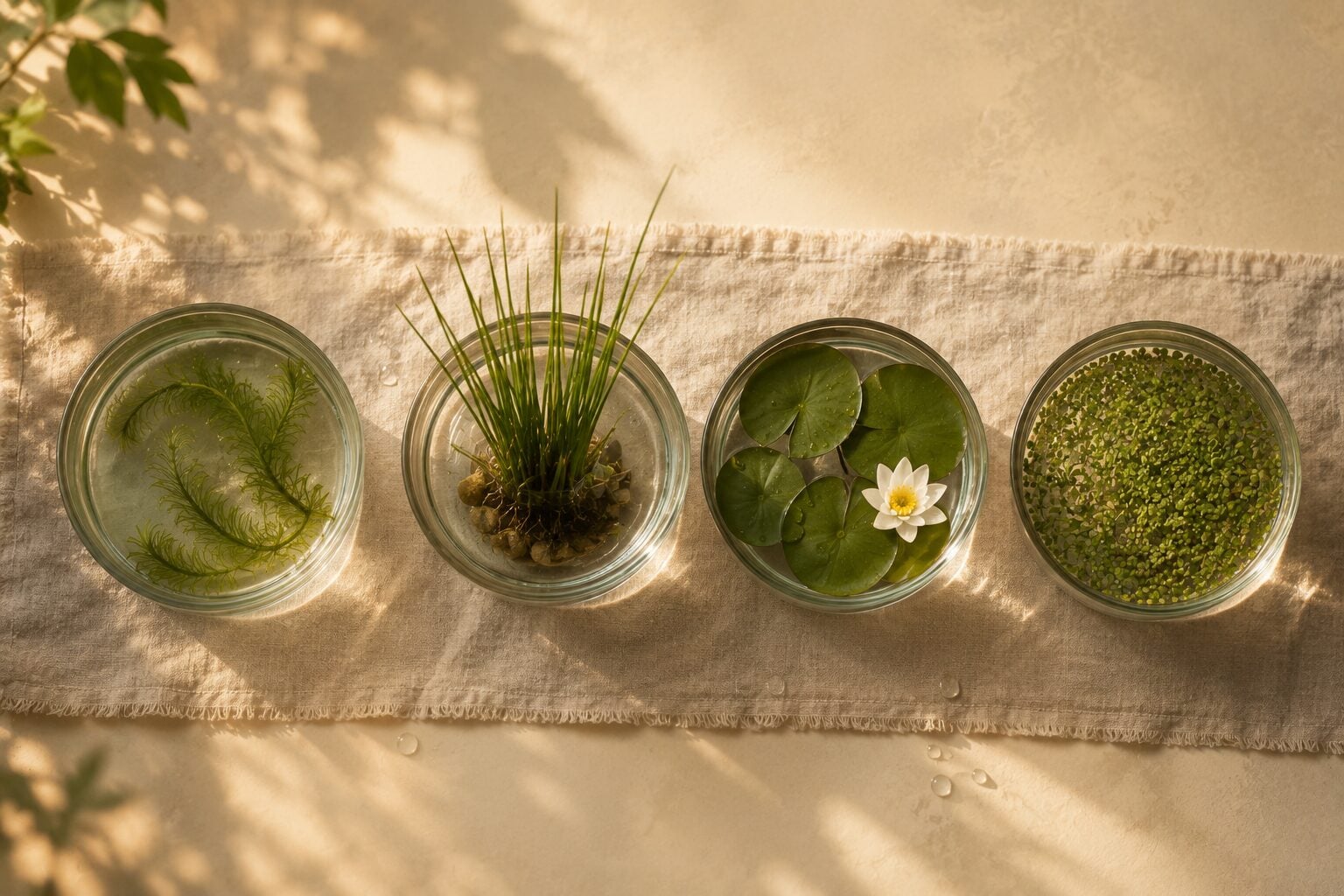
Submerged (submergent). Rooted at the bottom, growing up through the water column, with all or nearly all foliage underwater. Penn State lists elodea and naiad as classic examples. These do best in shallower water where light still reaches the bottom, which is exactly why they thrive in aquariums and struggle in deep, murky ponds.
Emergent. Rooted in saturated soil at the margins with stems and leaves standing above the surface. Cattail and bur-reed are the common ones. Along a pond bank, emergents are the erosion control crew — their root mats hold the shoreline and filter sediment runoff before it reaches open water. In a container garden they supply the vertical line that makes the whole arrangement read as designed.
Floating-leaf. Rooted in the bottom, with leaves that ride flat on the surface on long flexible petioles. Water lilies are the archetype. They tolerate deeper water than submerged species because their leaves come to the light rather than waiting for the light to come down.
Free-floating. Not rooted in soil at all; the entire plant drifts with roots dangling. Duckweed and watermeal are the famous ones, and they can carpet still water in a matter of weeks. UF/IFAS warns that a solid floating mat shades out everything beneath it, so free-floaters need regular thinning rather than admiration.
Aquatic plants for aquariums
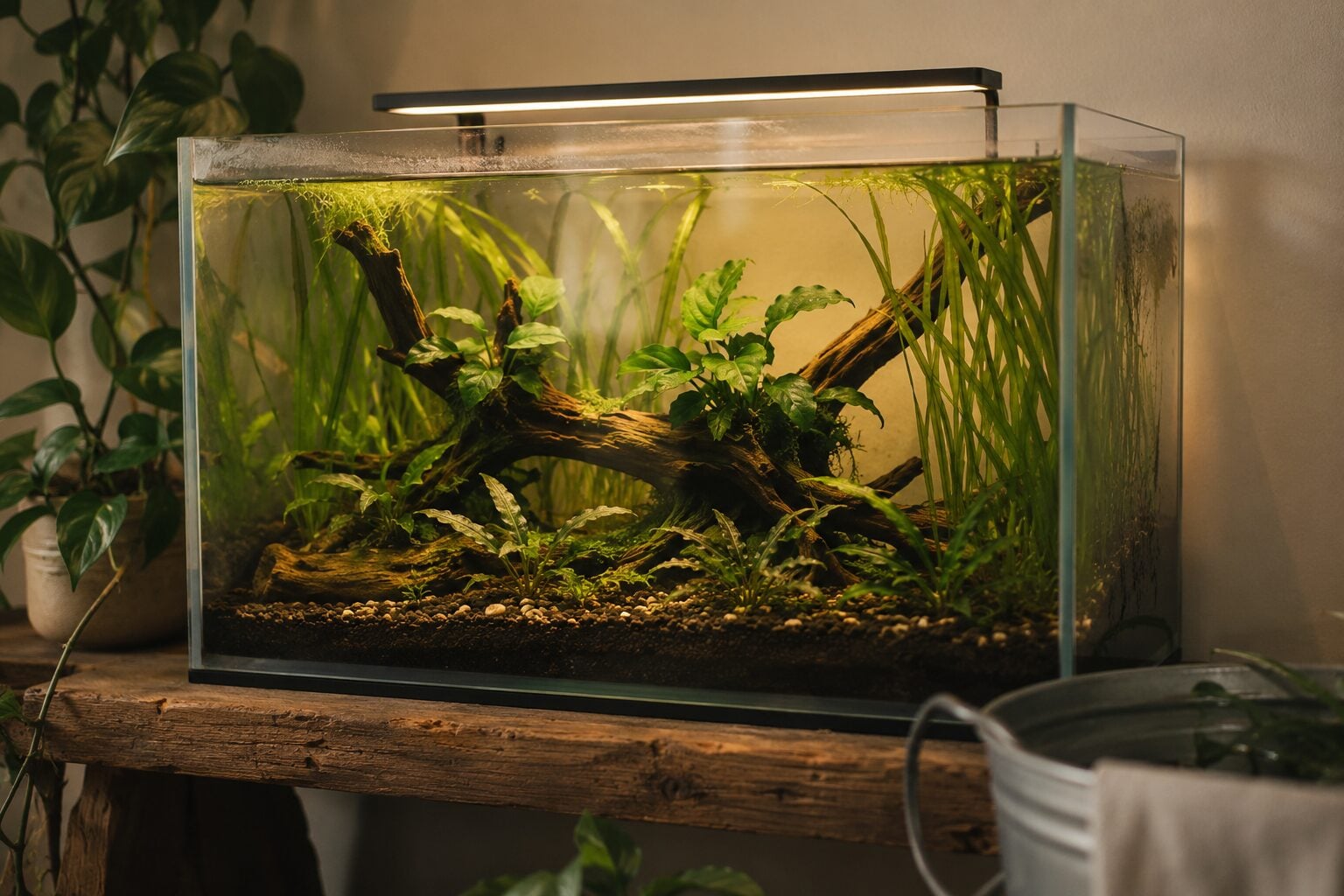
An aquarium is a controlled, warm, well-lit slice of shallow water, which makes it the easiest place to grow aquatic plants successfully. The mistake most beginners make is assuming they need pressurized carbon dioxide and a high-output light. They do not. A low-tech planted tank runs a photoperiod of six to eight hours a day at modest intensity — roughly 20 to 40 PAR at the substrate — with no injected CO2 at all.
Longer is not better. Running lights for ten or twelve hours in a low-tech tank does not make plants grow faster; it makes algae grow faster, because the plants hit their carbon ceiling long before the lights go off. Put the fixture on a plug timer, start at six hours, and only extend if growth is slow and the glass is clean. A simple adjustable full-spectrum planted-tank LED with a built-in timer removes most of the guesswork.
Substrate depth and root feeding
Aim for two to three inches of substrate overall, sloped deeper at the back (three to four inches) and shallower at the front (an inch and a half to two). The slope is partly aesthetic — it exaggerates depth — and partly practical, because it gives heavy root feeders somewhere to anchor while keeping the front open.
Heavy root feeders such as Amazon sword, cryptocoryne, and vallisneria pull most of their nutrition from the substrate. Push aquarium root tabs one to two inches down, spaced four to six inches apart through the planted areas, and replace them roughly every three months. A tab left sitting on the surface will dissolve into the water column and feed algae instead.
The one rule that kills the most beginner plants
Rhizome plants must never be buried. Anubias and Java fern grow from a horizontal rhizome that rots if you push it into the substrate. Tie or glue them to driftwood or stone with the rhizome fully exposed and only the roots making contact. This single mistake accounts for an enormous share of “my aquatic plants died for no reason” posts.
The forgiving beginner set is short and reliable: Anubias barteri var. nana, Java fern (Microsorum pteropus), Cryptocoryne wendtii, vallisneria, Amazon sword, water sprite, and hygrophila. All of them grow without CO2, tolerate a wide temperature and hardness range, and propagate on their own. For a species-by-species breakdown with sizes and growth rates, see our guide to the 12 best freshwater plants, and if you are still choosing livestock, the fish that will not shred them matter just as much.
Hardscape choice affects plants more than people expect, since some stone raises hardness and some wood leaches tannins. Our notes on aquarium plants and rocks cover which combinations stay neutral, and the full tropical fishtank setup walkthrough covers cycling before any plant goes in.
Aquatic plants for container water gardens
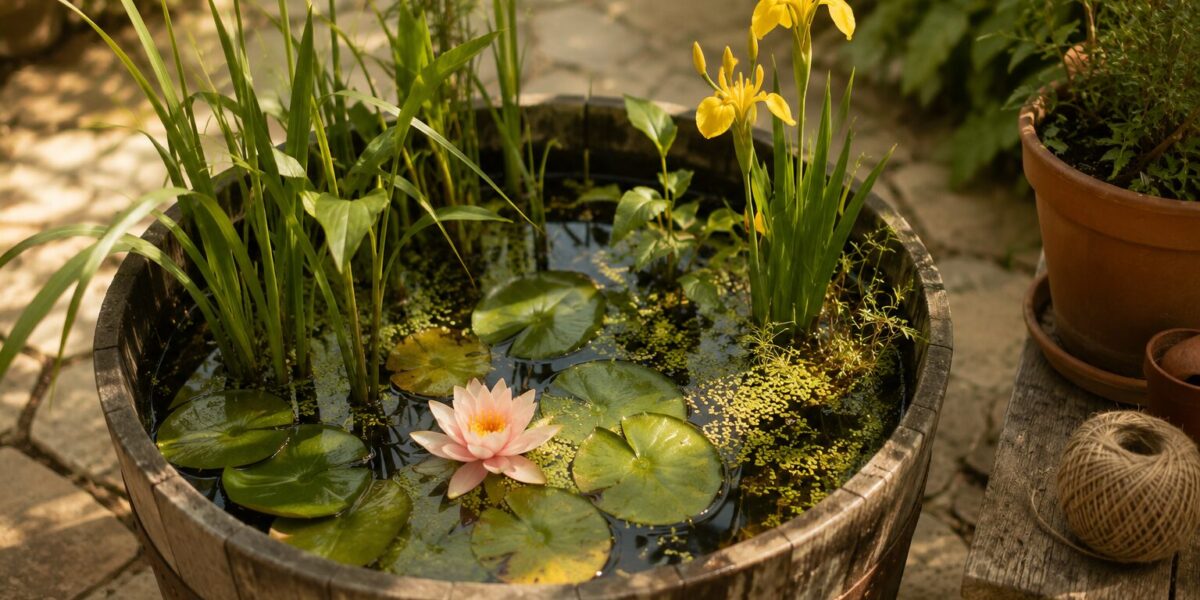
Outdoors, you do not need a dug pond. Illinois Extension points out that a water garden container can be anything from a single glazed pot up to a half barrel, a galvanized wash tub, or a livestock trough. The one caution with a wooden half barrel is to line it with plastic so wood preservatives cannot leach into the water and poison the plants.
Siting is simple and non-negotiable: a flat surface that gets six or more hours of direct sun a day. Flat matters because an uneven container spills and because planting shelves inside the pot need to sit level. Six hours matters because nearly every flowering aquatic plant worth growing is a sun plant.
How many plants fit
Every container has to hold enough water to cover each plant to its preferred depth — which means depth, not surface area, is your real constraint. Illinois Extension advises against crowding: two to three potted plants plus a few floaters make a striking arrangement, and more than that simply produces a tangle that shades itself out by August.
The classic composition uses one plant from each of three groups. Tall and spiky: cattail, yellow flag iris, sweet flag, rush, papyrus, or canna. Broad-leaved: lotus, taro, arrowhead, calla lily, or lizard tail. Flowering: water lily or water bluebell. One of each, plus a handful of floaters to shade the surface, and the tub looks intentional rather than collected.
Mosquitoes and safety
Still water breeds mosquitoes within about a week. Two fixes work together: keep the surface moving with a small solar fountain, and drop in Bti mosquito dunks, which target larvae with a bacterial toxin harmless to plants, birds, pets, and people. Also treat any open container as a genuine drowning hazard around toddlers — a wash tub of water is deep enough to matter.
Water lilies: planting depth and feeding
Water lilies (Nymphaea) are the plant most people picture when they picture aquatic plants, and they are demanding in exactly two ways: depth and food. Hardy types overwinter as perennials across roughly USDA zones 3 through 11; tropical types are perennial only in zones 10 and 11 and are grown as annuals everywhere else.
Depth is measured as water above the top of the pot, and it scales with the variety. Dwarf lilies want six to twelve inches over the pot, small varieties twelve to twenty-four, and medium to large varieties eighteen to thirty-six. Too deep and the plant exhausts itself pushing petioles to the surface; too shallow and the pads bunch up and stand on edge instead of lying flat.
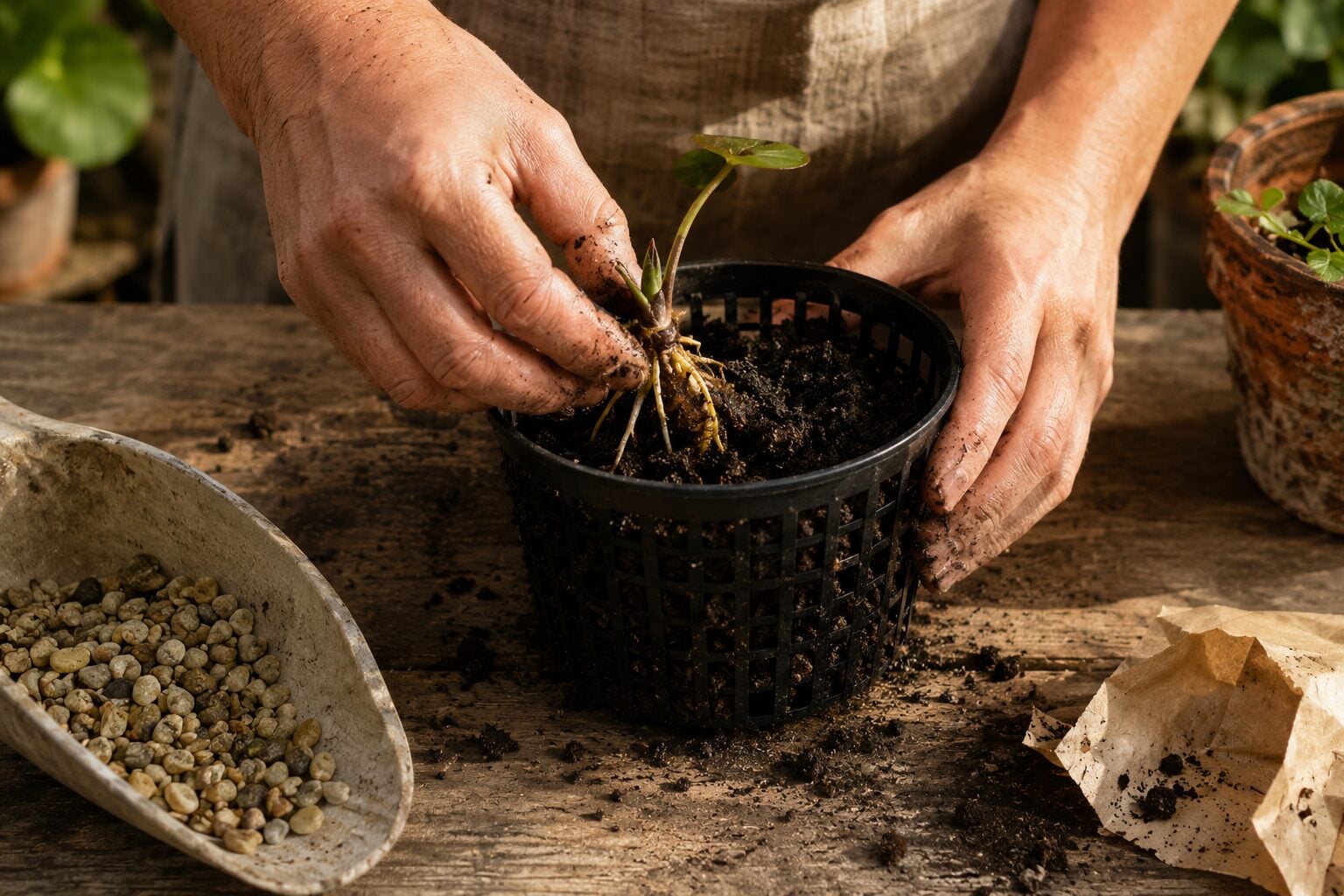
When potting, use heavy loam or a dedicated pond soil — never a peat-based potting mix, which floats out and clouds the water. Set the growing tip at or just barely below the soil surface, then top-dress with an inch of pea gravel to keep the soil in the pot and the fish out of it. A basket-and-soil combination such as an aquatic plant pot and pond soil kit saves a lot of trial and error.
Lilies are heavy feeders. Push pond fertilizer tablets into the pot monthly through the growing season and taper off in late summer so the plant slows down naturally before cold weather. In freezing climates, Colorado State’s PlantTalk guidance is to lower hardy lily pots below the ice line for winter and lift them back to normal depth in spring; tropicals get treated as annuals or overwintered indoors as tubers.
Light, water quality, and algae
Algae is not a separate problem from aquatic plants; it is the same problem viewed from the other side. Algae wins when light and nutrients exceed what your plants can use. Indoors, that means capping the photoperiod at six to eight hours before increasing fertilizer. Outdoors it means keeping nutrient loading down and letting floating-leaf coverage shade roughly half the surface, which starves suspended algae of light.
Top off with rainwater or unsoftened tap water. Water from a sodium-based softener carries salts that accumulate every time you top off and stress both aquarium and pond plants over a season. If your tap is softened, run a bypass line to an outdoor spigot or collect rain in a covered barrel.
Temperature ranges are wider than most guides suggest. Tropical aquarium species are comfortable from about 72 to 82°F, while hardy pond plants tolerate anything from near-freezing water in winter to the high 80s in a shallow tub in July. Shallow containers swing hardest — a black stock tank in full sun can cook plants that would be fine in a deeper pond.
Never release aquatic plants into the wild
This is the part of the hobby that carries real consequences. Illinois-Indiana Sea Grant’s guidance is unambiguous: dispose of unwanted water garden and aquarium plants in sealed bags in the household trash, or compost them well away from water — never in a stream, lake, ditch, or storm drain.
The reason is history. Hydrilla, once sold as an aquarium plant, and giant salvinia are now federally listed noxious weeds; moving them across state lines without a USDA permit is illegal. Water hyacinth, a beautiful and genuinely useful container plant, is banned or restricted in many states because escaped mats block navigation and cost millions annually in control. Buy from sellers who label regional restrictions, and check your own state list before ordering.
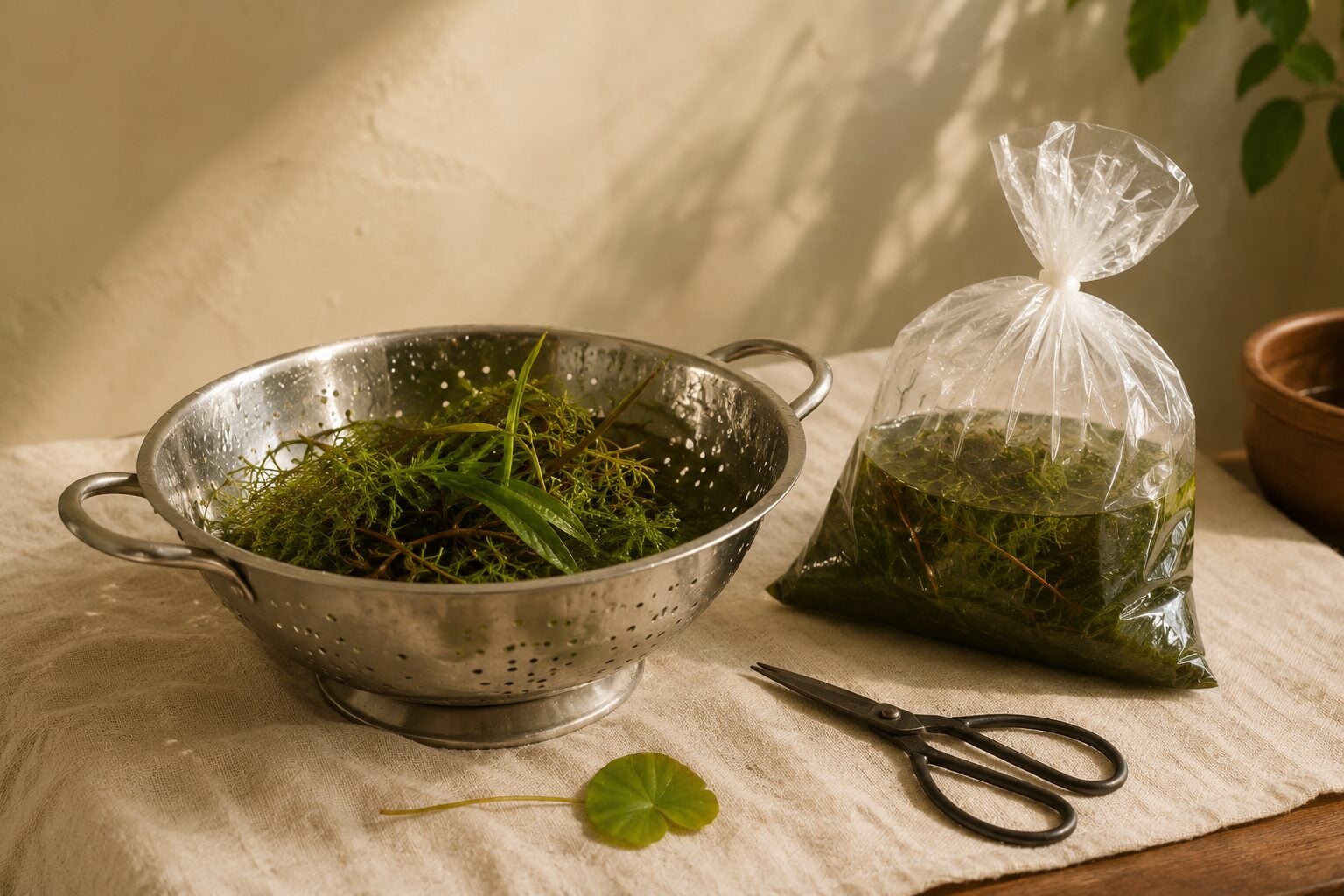
Rinsing new plants before they go in is also worth the two minutes. A quarantine bucket for a week catches hitchhiking snails, planaria, and fragments of species you did not order.
Pet and household safety
Not every water plant is harmless to a curious dog or a cat that drinks from the tub. Calla lily (Zantedeschia) and taro or elephant ear (Colocasia) are both listed by the ASPCA as toxic to cats and dogs; they contain insoluble calcium oxalates that cause immediate oral pain, drooling, and vomiting when chewed. They are still worth growing — just not at nose height in a household with a plant-chewing pet.
Water lily in the genus Nymphaea is listed as non-toxic to cats and dogs, which trips people up because the word “lily” is doing double duty. True lilies (Lilium) and daylilies (Hemerocallis) are severely toxic to cats and cause acute kidney failure; they are unrelated to water lilies. If a pet has chewed anything you are unsure about, the ASPCA plant database and your veterinarian are the right first calls.
Troubleshooting aquatic plants
| What you see | What it usually means | What to do |
|---|---|---|
| New cryptocoryne leaves melt to mush within days | “Crypt melt” — the plant converting from emersed nursery growth to submerged growth | Leave the roots alone, keep parameters stable; new submerged leaves follow in 2–4 weeks |
| Yellowing leaves with pinholes | Nutrient deficiency, usually potassium or iron | Add root tabs for root feeders, a liquid comprehensive fertilizer for column feeders |
| Brown dusty film on glass and leaves in a new tank | Diatoms during cycling — normal, silicate-driven | Wipe it off, wait it out; it clears as the tank matures |
| Lily pads standing upright out of the water | Planted too shallow for the variety | Lower the pot until the pads lie flat |
| Healthy lily foliage but no flowers | Too little sun or too little food | Move to six-plus hours of sun, resume monthly fertilizer tablets |
| Duckweed covering the entire surface | Free-floaters outcompeting everything below | Skim weekly with a net; keep coverage near half the surface |
Where to start
If you want aquatic plants indoors this month, start with a rhizome plant tied to wood, one cryptocoryne, and a six-hour light timer — that combination is nearly impossible to kill. If you want them outdoors, start with a lined half barrel, one dwarf water lily potted at the correct depth, one upright emergent for height, and a mosquito dunk.
Specialist growers are worth knowing about as you get pickier. Buce Plant and Aquarium Co-Op ship tissue-culture and rhizome aquatic plants that arrive free of snails and algae, which is a real advantage over big-box livestock counters, and small Etsy makers turn out glazed water bowls that beat a plastic tub for looks. Browse the rest of our aquatic plants library when you are ready for a second tank or a second tub — which, fair warning, happens to almost everyone by the following spring.
The planted tank starter kit
- API ROOT TABS Freshwater Aquarium Plant Fertilizer 0.4-Ounce 10-Count… — aquarium root tabs
- hygger Clip On Full Spectrum Aquarium LED Light, 22W Day-Night Dual… — adjustable full-spectrum planted-tank LED
- Doter Aquatic Soil for Plants – 2.2LBS, Clay Aquarium Soil Suitable… — aquatic plant pot and pond soil kit
- Mosquito Dunks 6's – Biological Mosquito Control — bti mosquito dunks
Opens Amazon’s cart confirmation page — you review the list and prices there, and nothing is added until you approve it. Prefer to pick and choose? Every item above links to its own product page.


Leave a Reply