🌿 Some links in this post are affiliate links. If you shop through them, we earn a small commission at no extra cost to you. It's one of the best ways to support Humble Acres. Thank you!

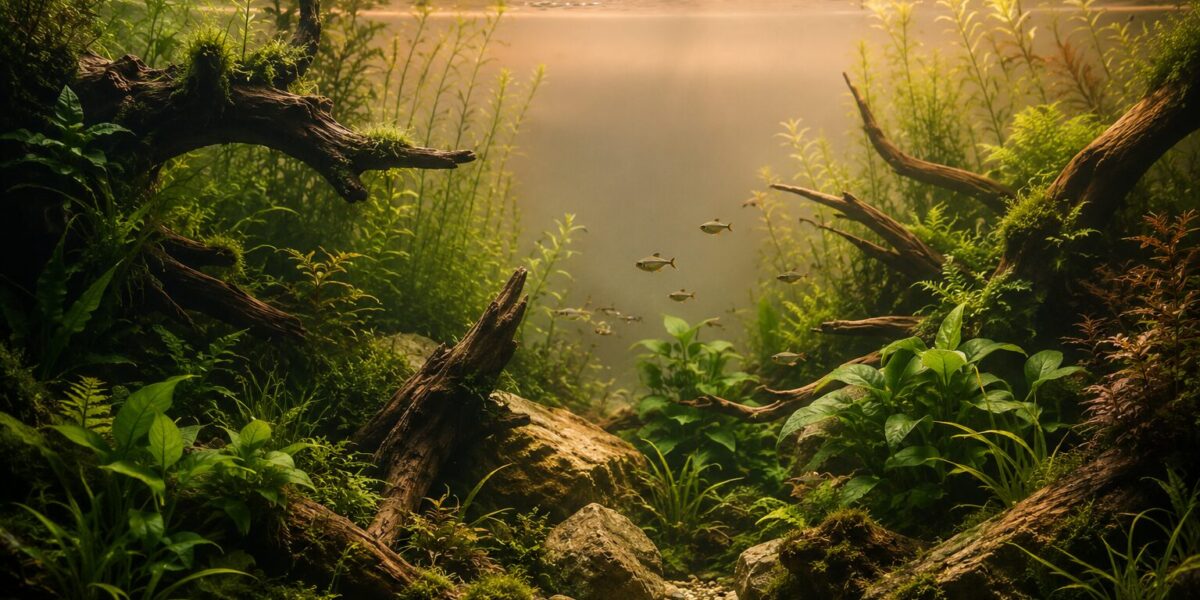
A planted aquarium with rocks and driftwood is one of the most visually striking things you can create as a hobbyist. It’s also one of the healthiest environments you can build for fish — live plants oxygenate the water, absorb nitrates, and provide shelter that reduces fish stress. The hardscape (rocks and wood) creates structure and a natural, cohesive look that fake plants simply can’t replicate.

This guide covers how to combine aquarium plants and rocks into a balanced, low-maintenance aquascape — including the best plant choices, the right rocks, and how to set it all up.

Why Live Plants Make a Better Aquarium

Beyond aesthetics, live aquatic plants actively improve water quality. They absorb ammonia, nitrite, and nitrate — the toxic byproducts of fish waste — through their leaves and roots, reducing the load on your filter and making water changes less urgent. They also produce oxygen during daylight hours and compete with algae for nutrients, keeping algae growth in check naturally.

Fish and shrimp behave more naturally in planted tanks too. They explore plant leaves, use them as cover from light and other fish, and in many species, use broad leaves as spawning sites.

Choosing Rocks for a Planted Aquarium

Not all rocks are safe for aquariums. Rocks containing calcium carbonate (limestone, marble, coral) will dissolve slowly and raise water hardness and pH — fine for some fish but problematic for soft-water species like tetras and discus.

The safest rocks for most planted aquariums:

  • Dragon stone (Ohko stone) — light, porous, with dramatic holes and ridges. Neutral pH effect. Ideal for Dutch and nature-style aquascapes.
  • Seiryu stone — grey-blue angular rock with white veining. Does raise pH slightly over time, so best in harder water setups.
  • Lava rock — rough, red-black porous rock. Completely inert, benefits from beneficial bacteria colonization in the pores. Very affordable.
  • Slate — flat, stackable, inert. Great for creating terraced levels in an aquascape. Easy to split into shapes with a chisel.

Shop lava rock for aquariums on Amazon →

Shop seiryu stone on Amazon →

Shop dragon stone / ohko stone on Amazon →

Test unknown rocks with white vinegar — if it fizzes, the rock contains calcium carbonate and will affect pH. Avoid it for soft-water tanks.

Best Aquarium Plants for Beginners

Java Fern (Microsorum pteropus)

Java fern is the first plant most aquascapers recommend, and for good reason. It’s nearly indestructible, grows in low light, and doesn’t need CO2 injection or special substrate. Critically: don’t plant it in substrate — attach it to rocks or driftwood with fishing line or super glue gel, and it will root itself in place. Burying the rhizome kills it.

Shop Java fern (live) on Amazon →

Anubias

Shop Anubias barteri (live) on Amazon →

Anubias is another rhizome plant that should be tied to hardscape rather than planted. It grows extremely slowly but is virtually bulletproof — it tolerates low light, high nitrates, and inconsistent care that would kill most other plants. Its broad, dark green leaves provide excellent cover for fish. Anubias barteri and Anubias nana are the most common varieties.

Vallisneria (Val)

Vallisneria produces long, grass-like leaves that sway in the current — one of the most beautiful background plants available. It spreads via runners and can fill the back of a tank quickly. Grows best in substrate and appreciates moderate light, but is otherwise undemanding. A planted tank classic.

Java Moss

Java moss is the most versatile aquarium plant available. Tie it to rocks and driftwood to create a natural, overgrown look. Leave it loose in a breeding tank for fish and shrimp fry to hide in. It grows in almost any conditions — low light, no CO2, wide temperature range. Shrimp particularly love picking through it for biofilm and algae.

Shop Java moss (live portion) on Amazon →

Cryptocoryne (Crypt)

Crypts are mid-ground plants that come in dozens of species — green, bronze, red, ruffled, smooth. They’re planted in substrate and prefer moderate light. New plants will often “melt” when first introduced (leaves dissolve), which is alarming but normal — new leaves grow back adapted to your specific water. Give them 4–6 weeks to establish.

Aquascape Layout Principles

A well-composed aquascape follows a few simple rules:

  • The rule of thirds — place your main focal point (a large rock grouping, a dramatic piece of driftwood) off-center, roughly one-third from the left or right edge.
  • Front to back depth — use low foreground plants, medium mid-ground plants, and tall background plants to create a sense of depth.
  • Odd numbers — rock groupings of 3, 5, or 7 look more natural than symmetrical pairs.
  • Leave open space — empty water space gives fish room to swim and prevents the tank from looking cluttered.

Substrate for Planted Aquariums

For a low-tech planted tank, fine gravel or aquarium sand works fine for the plants listed above. For more demanding plants and faster growth, a nutrient-rich planted substrate like ADA Aqua Soil, Fluval Stratum, or similar provides the root nutrition that planted tanks need without regular fertilizer dosing.

Shop planted tank LED lights on Amazon →

Shop Fluval Plant & Shrimp Stratum on Amazon →

Shop ADA Aqua Soil Amazonia on Amazon →

A layer of 2–3 inches of substrate gives roots enough depth to anchor properly. Shallower substrate leads to unstable plants that uproot easily.

Low-Tech vs. High-Tech Planted Tanks

A low-tech tank uses no CO2 injection, standard LED lighting, and slow-growing plants. It’s the best starting point — less equipment, lower cost, and more forgiving of mistakes. The plants listed in this guide all do well in a low-tech setup.

A high-tech tank adds pressurized CO2, high-output lighting, and regular liquid fertilization. Growth is dramatically faster and allows for more demanding carpet plants and complex layouts — but the margin for error is much smaller. Algae blooms from CO2 fluctuations and excess nutrients are common beginner pitfalls.

Start low-tech. Master the fundamentals. Upgrade later if you want to explore aquascaping competitions and complex Dutch-style layouts.

For more on the plants that work best in vivariums and terrariums alongside aquatic setups, see our terrarium plants guide and aquatic plants category.