🌿 Some links in this post are affiliate links. If you shop through them, we earn a small commission at no extra cost to you. It's one of the best ways to support Humble Acres. Thank you!

Air plants — the common name for Tillandsia — are unlike almost every other plant you’ll encounter. They need no soil, survive on mist and airflow, and come in over 650 species ranging from tiny silver wisps to large architectural specimens. They’re not delicate novelties, either. With the right care, they live for years and regularly produce pups (baby plants) that you can separate and grow on.

Shop fine mist spray bottles on Amazon →

This guide covers everything you need to know about air plant care — how to water, where to place them, how to mount and display them, and how to keep them blooming.

How Air Plants Actually Get Their Nutrients

Tillandsia are epiphytes — in the wild, they grow on tree branches, rocks, and cliff faces, absorbing water and nutrients through tiny scales on their leaves called trichomes. Their roots are primarily for anchoring, not feeding. This is why soil is irrelevant (and actually harmful — it traps moisture around the base and causes rot).

In your home, you replace the natural humidity and rainfall of their native Central and South American habitat with regular misting or soaking.

How to Water Air Plants

There are two main watering methods for air plants, and which one you use depends on your climate and your schedule:

Soaking (Best for Most Indoor Conditions)

Submerge the entire plant in room-temperature water for 20–30 minutes once a week. After soaking, shake off excess water gently and place the plant upside down on a towel for an hour to drain. This is critical — water pooling in the cup (center) of the plant causes rot. Once drained, return to its display spot.

Misting (For Xeric Varieties and Mounted Displays)

Misting works well for xeric air plants (the fuzzy, silver-leafed varieties like T. tectorum or T. xerographica) which prefer less water. Mist thoroughly 2–3 times per week until the leaves are dripping, then allow to dry completely within 4 hours.

Use tap water that has sat out overnight (to off-gas chlorine), filtered water, or rainwater. Avoid softened water — the added sodium damages trichomes over time.

Light Requirements

Most air plants prefer bright, indirect light. An east or west-facing window is ideal. They can tolerate a few hours of direct morning sun but will scorch in harsh afternoon sun.

The silver, fuzzy-leafed varieties (xeric types) are adapted to full sun in dry environments and handle direct light better. The green, smoother-leafed varieties (mesic types) prefer shadier conditions.

Under artificial lighting, a full-spectrum LED grow light 6–8 inches from the plant for 12 hours a day works well.

Popular Air Plant Varieties

Tillandsia ionantha

Shop Tillandsia ionantha (bulk packs) on Amazon →

The most widely sold air plant, and a great starting point. Small (2–4 inches), tough, and spectacular when blooming — the leaves turn red or pink before producing a purple flower. Produces pups freely after blooming.

Tillandsia xerographica

The king of air plants. Large, sculptural, with wide silver leaves that curl dramatically. Very slow-growing and drought-tolerant — water every 10–14 days. Makes a stunning centerpiece on its own. Worth the higher price tag.

Tillandsia stricta

Shop Tillandsia stricta on Amazon →

A reliable, easy-care species with soft green leaves and a beautiful pink-and-purple flower. Grows in a rosette shape, produces pups readily, and adapts well to a wide range of humidity levels. Great for beginners.

Tillandsia bulbosa

Bizarre and wonderful — bulbosa has an inflated, hollow base and tentacle-like leaves that curl and twist. It looks almost alien. Loves humidity, making it a great choice for bathrooms or humid kitchens.

How to Display Air Plants

The best thing about air plants is the creative freedom in display. With no soil required, they can go almost anywhere:

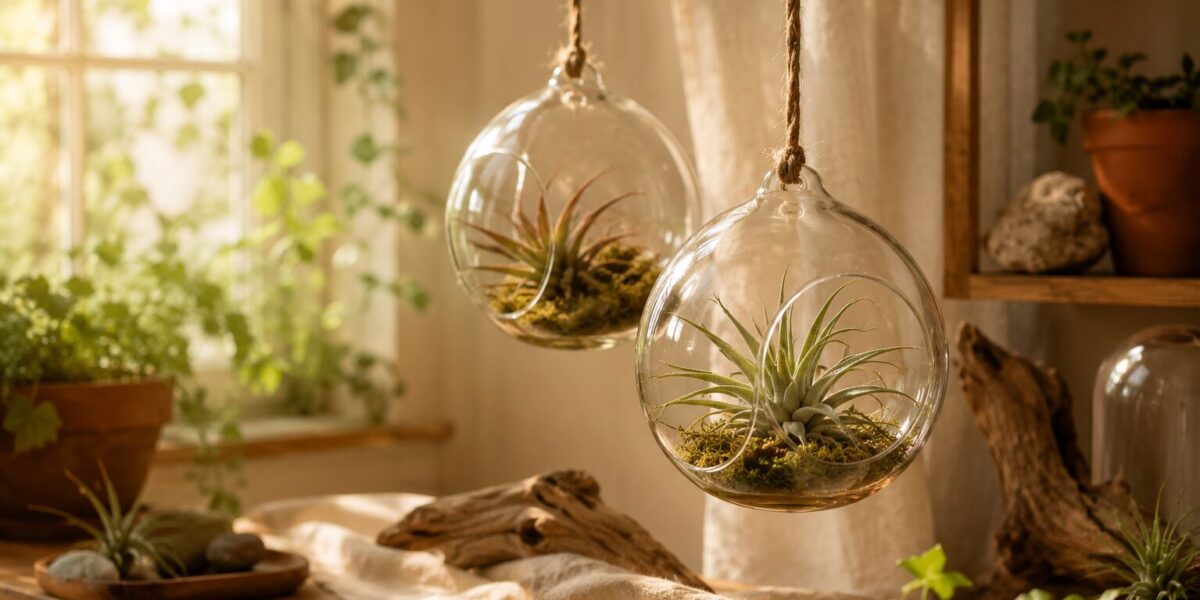
  • Mounted on driftwood or cork bark — attach with fishing line, floral wire, or non-toxic glue. The roots will eventually anchor themselves.
  • In open terrariums — glass globes, geometric frames, and open vessels work beautifully. Avoid closed terrariums — airflow is essential.
  • In shells, stone bowls, or on rocks — just ensure the base of the plant doesn’t sit in standing water.
  • Hanging in wire frames or macramé holders — suspending them upside down actually helps water drain properly after misting.

Shop glass globe terrariums for air plants on Amazon →

Shop driftwood for air plant displays on Amazon →

Avoid copper wire — it’s toxic to Tillandsia. Galvanized or plastic-coated wire is fine.

Blooming and Pups

Each air plant blooms once in its lifetime, then produces 2–8 pups (offsets) before the mother plant slowly dies. This isn’t a failure — it’s the plant’s reproductive cycle. The mother plant continues to support the pups for months as they grow, and the pups can be separated once they’re about one-third the size of the mother plant.

To encourage blooming, provide consistent care, good light, and try a monthly application of diluted bromeliad fertilizer (at 1/4 strength) in the soaking water.

Shop bromeliad fertilizer on Amazon →

Common Problems

  • Brown, crispy leaf tips — underwatering or low humidity. Increase soak frequency or mist between soaks.
  • Soft, mushy base — root rot from water sitting in the crown. Always invert to drain after watering. Remove any brown, mushy leaves at the base.
  • Pale, washed-out color — too much direct sun. Move to brighter indirect light.
  • No growth — usually insufficient light or water. Both must be adequate for the plant to thrive.

Air plants pair beautifully with open terrariums and driftwood displays. See our terrarium plants guide for ideas, or browse our air plants category for more species guides.